How to Ask a Professor for a Recommendation Letter
When to ask, what to send, and the exact emails to use, plus how professors can handle a stack of letter requests without missing a deadline.
Ask six to eight weeks before your first deadline, and ask someone who knows your work, not just your grade. Make the request short, then send one tidy packet: your CV, a draft of your statement, and a list of every program with its deadline and how the letter is submitted. Waive your right to read the letter, send one reminder a week before the deadline, and tell your recommender where you got in.
That is the whole method. The rest of this guide gives you the emails word for word, the packet, a timeline, and what to do when something goes wrong. The last section is for professors, who can receive fifteen of these requests in the same month.
Who to ask
The best letter comes from the person who has watched you do the kind of work the program cares about. For a research degree, that ranking usually looks like this:
- Your research supervisor, from a thesis, a summer project or a lab job. They can describe how you handle a failed experiment, which is exactly what an admissions committee wants to know.
- A professor whose course you did something substantial in: a project, a long paper, office-hours conversations. A grade alone gives them one sentence to write.
- An employer or research lead outside a university, if the work was technical and they can speak to it in detail.
A famous name who barely knows you writes a short, careful letter. Committees read many letters and recognise the difference. Choose depth over status.
Most graduate programs ask for two or three letters; Stanford, for example, requires three for every graduate application. Line up a fourth person in case one of your three cannot do it.
When to ask: the timeline
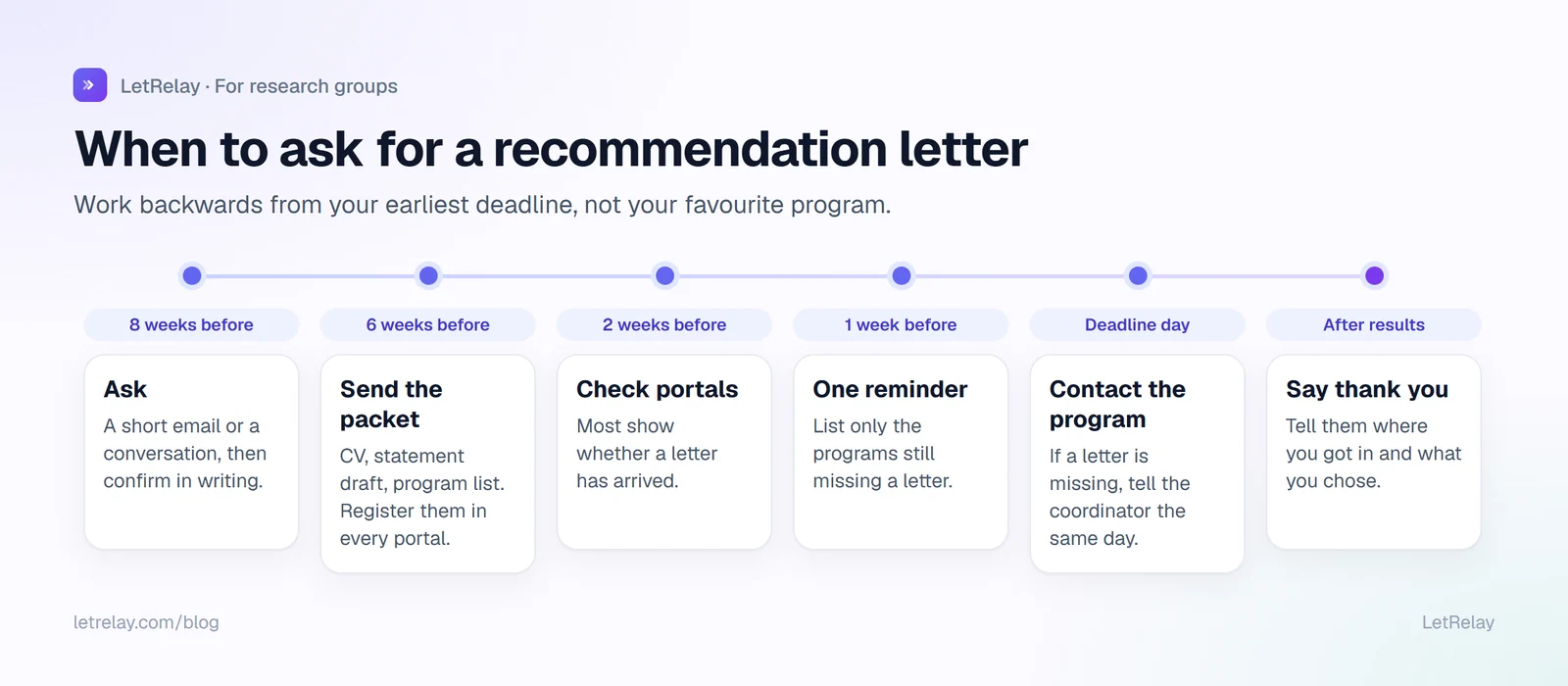
Arizona State University's career service advises asking at least six to eight weeks ahead, which leaves room for reminders. Work backwards from your earliest deadline, not your favourite program's.
| When | What you do |
|---|---|
| 8 weeks before | Ask. Short email or a conversation, then follow up in writing. |
| 6 weeks before | Send the packet (below) and register the recommender in every application portal. |
| 2 weeks before | Check each portal. Most show whether a letter has been received. |
| 1 week before | One polite reminder listing only the programs still missing. |
| Deadline day | If a letter is still missing, contact the program, not just the professor. |
| After results | Tell them where you got in and what you chose. Thank them properly. |
Register your recommenders early in the portals. Application systems usually email each recommender a personal upload link as soon as you enter their details, so a late registration shortens their time even if you asked early.
The request email
Keep it to a few sentences. The goal of the first email is only to get a yes or a no. Give them an easy way to say no; a reluctant letter is worse than none.
If you worked with them recently:
Subject: Recommendation letter for PhD applications (first deadline 1 December)

Dear Professor Okafor,

I am applying to PhD programs in computational biology this autumn, and
I would be grateful if you would write one of my recommendation letters.
Working on the gene-expression pipeline in your lab this summer is the
main reason I am applying, and you know that work better than anyone.

The first deadline is 1 December, and there are six programs in total.
If you are able to, I will send my CV, statement draft and a list of the
programs with their deadlines by the end of this week.

I completely understand if this term is too busy.

Best regards,
Amara Chen
If it has been a while:
Subject: Recommendation letter request from a former student (ECON 402, 2025)

Dear Professor Lindqvist,

I took your Econometrics II course in spring 2025 and wrote my term paper
on minimum-wage spillovers, which you gave detailed feedback on. I am now
applying to master's programs in public policy and would be honoured if
you could write me a recommendation letter.

The first deadline is 15 January. I can send my CV, the term paper and
a short summary of what I have done since, so you have everything in one
place. If you do not feel you know my work well enough, I understand.

Kind regards,
Jonas Weber
Put the course, the year and one specific piece of work in the first lines. Professors teach hundreds of students; you are giving them the memory, not asking them to find it.
The packet: everything in one email
Once they say yes, send one email with everything attached, so they never have to search their inbox.
Subject: Letter packet: PhD applications, 6 programs, first deadline 1 Dec

1. Program list (table below): program, deadline, how the letter is
   submitted (portal link, email, form), and anything specific the
   program asks recommenders to comment on
2. CV
3. Statement of purpose draft
4. A one-page summary of our work together:
   - what I did, with dates
   - one or two results or moments you might remember
   - the skills I hope the letter can speak to (for example: independent
     troubleshooting, writing, teaching the new undergraduates)
5. Transcript (unofficial is fine)
The one-page summary matters most. It is not a draft of the letter; do not write the letter for them unless they explicitly ask. It is a list of facts they can check against their own memory.
Should you waive your right to see the letter?
In the United States, FERPA lets a student waive the right to read confidential recommendation letters. Application portals ask you to choose. Almost every advisor, and almost every admissions office, will tell you to waive it: a letter the applicant cannot read is taken as more candid, and some professors will only write confidential letters.
The regulation behind this (34 CFR 99.12) also protects you. An institution cannot require the waiver as a condition of admission, and if you do waive it, you can still ask for the names of the people who wrote your letters. Outside the US the legal details differ, but confidential letters are the norm almost everywhere.
Reminders without being annoying
One reminder, one week before the deadline, is normal and expected. Make it a list of what is still missing, so it takes ten seconds to act on:
Subject: Reminder: 2 letters still pending (due 1 December)

Dear Professor Okafor,

Thank you again for writing my letters. The portals show that four
have arrived. Two are still pending:

- University A, Computational Biology PhD, due 1 December (portal link)
- University B, Systems Biology PhD, due 3 December (portal link)

Please let me know if anything is missing on my side.

Best,
Amara
Do not send a reminder for a letter that the portal shows as received, and do not remind more than once a week.
When something goes wrong
They do not reply within a week. Send one short follow-up. If there is still no answer after another week, ask your backup recommender. Silence is often a busy inbox, not a no, but your deadline will not wait.
They say no. Thank them and move on. A professor who declines is doing you a favour.
The deadline is tomorrow and the letter is missing. Email the program's graduate coordinator the same day: say which letter is outstanding and that it is on its way. Some programs accept letters for a short time after the application deadline; some do not. Only the program can tell you.
You need letters for many programs. Group them. Recommenders can usually reuse one letter across similar programs, so a list of fifteen programs with the same deadline cluster is far less work than it looks, as long as it is one list.
For professors: handling letter season
For a PI, recommendation letters are pleasant work that arrives in an unpleasant shape: a dozen requests, each with its own portal and date, spread across email threads. A few habits keep it manageable. (Writing the letter itself is a separate skill: see how to write a recommendation letter for a grad student.)
- Publish a minimum notice. "I need four weeks and the full packet" on your lab page or in your lab handbook removes most last-minute requests.
- Ask for the same packet every time. Link a request checklist (the packet above works) so every student sends the same pieces.
- Keep one list, sorted by deadline. Not a folder of emails. One row per letter: student, program, deadline, submission method, status.
- Write a master letter per student. Most letters for the same student differ in one paragraph. Keep the master next to the student's record, and update it each year.
- Confirm when you submit. A one-line "done" stops the reminder emails before they start.
- Decline early when you should. If you cannot write a strong letter, say so in the first week. Students can recover from a no; they cannot recover from a weak letter on 30 November.
A lab with ten students and a few visiting undergraduates can easily have forty letters in a season. At that volume the list, not memory, is what keeps deadlines from being missed. The same habit, one list instead of scattered threads, is how a PI keeps the rest of a group on track too; see how to run a research group without chasing students.
How LetRelay does it
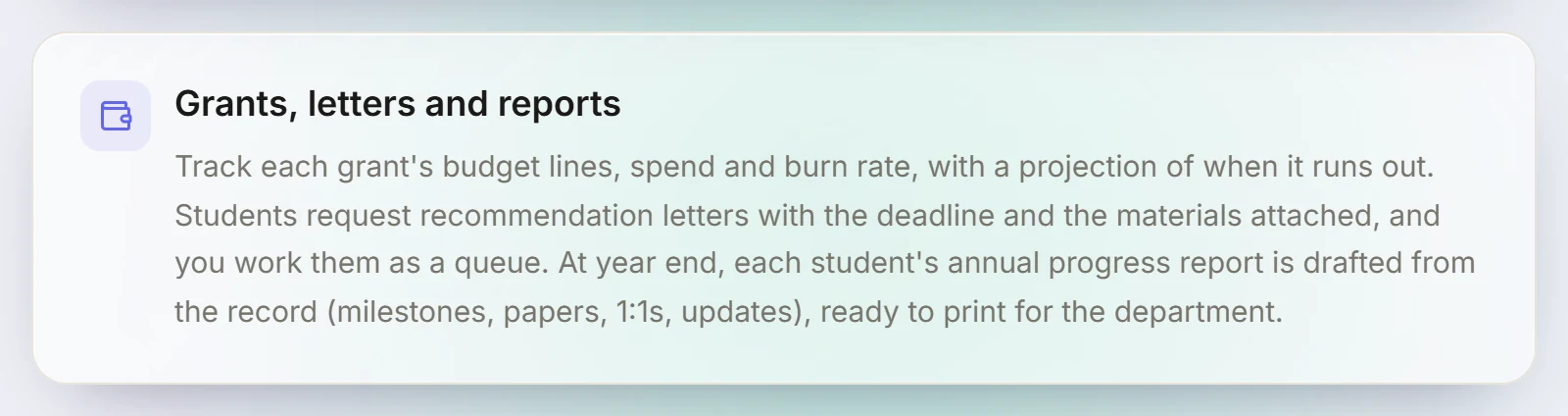
In a LetRelay research group, a student requests a recommendation letter from inside the workspace, with the deadline and the materials attached, and the professor works through requests as a queue sorted by due date. The request, the attachments and the deadline stay together, so nothing depends on finding the right email thread in November. The same record feeds the student's annual progress report at year end. More on the LetRelay for research groups page.
FAQ
How far in advance should I ask a professor for a recommendation letter?
Six to eight weeks before your earliest deadline. That gives the professor time to write and gives you time to find a backup if they cannot. If you have less than four weeks, say so in the first line of your email and make the packet complete; less than two weeks is a real imposition.
How many recommendation letters do I need for grad school?
Usually two or three, and three is the most common requirement for PhD programs. Check each program's page, and have a fourth recommender in mind in case someone drops out.
Can I ask a professor who does not know me well?
You can, but the letter will be short. If you must, give them more material: the course, your work in it, a copy of your best paper, and what you have done since. A detailed letter from a lecturer usually beats a vague one from a department head.
Should I waive my right to see my recommendation letter?
In most cases, yes. Committees trust confidential letters more, and some professors only write confidential ones. Under US rules a school cannot make the waiver a condition of admission, and you can still ask for the names of your letter writers.
How do I politely remind a professor about my recommendation letter?
Send one short email a week before the deadline that lists only the programs still missing a letter, with the deadline and the submission link for each. Thank them for the letters already sent. That is a reminder they can act on in a minute.
What if my professor misses the recommendation letter deadline?
Contact the program's graduate coordinator the same day, explain which letter is outstanding, and ask whether it can still be accepted. Then send the professor a brief, friendly note with the direct submission link. Many programs are used to this; the ones that are not will tell you quickly.
Sources
Building LetRelay, the workspace for research groups and small teams: lab management, supervision tools, and an internal request desk with AI triage and SLA tracking.
Run your internal requests on LetRelay
AI triage, SLA-tracked queues, and bottleneck analytics — the help desk your team actually likes. Free to start.
Keep reading
How to Email a Potential PhD Supervisor (With Examples)
When emailing a professor helps your PhD application and when it does not, what to write, two example emails, and how PIs can handle inquiries fairly.
Lab Onboarding Checklist for New PhD Students and Members
A lab onboarding checklist for the first day, first week and first month of a new PhD student, postdoc or visiting researcher, plus the offboarding list that keeps data and keys from walking out the door.
PhD Weekly Update Template (With Real Examples)
A weekly update a PhD student can write in three minutes and a supervisor can read in thirty seconds. The template, good and bad examples, versions for each stage of the degree, and how supervisors should answer.