How to Email a Potential PhD Supervisor (With Examples)
When emailing a professor helps your PhD application and when it does not, what to write, two example emails, and how PIs can handle inquiries fairly.
A good email to a potential PhD supervisor is four short paragraphs: who you are, what specifically in their recent work you want to build on, the evidence that you can do it, and one clear question, usually whether they expect to take a student for the year you are applying. Attach your CV, use a subject line that says what the email is, and follow up once after a week or two.
Whether you should send it at all depends on the country and the department, and that is where most advice online is wrong. Below: when emailing matters, two example emails, the mistakes that get an email deleted, and a section for PIs on handling inquiries without spending a day a week on them.
First: does emailing a professor even matter?
It depends on who makes the admission decision.
Departments that admit by committee. Many US PhD programs, especially in the biomedical sciences and in programs with lab rotations, admit students to the department first; students choose a lab later. Stanford's Electrical Engineering PhD FAQ is blunt about it: contact with faculty is not required, does not guarantee admission, and decisions are made by the admissions committee, not individual faculty. Here an email is optional. It can still be useful to confirm a professor is taking students, but it will not get you in.
Departments that admit to a lab. Other programs want you to have a supervisor in mind, and some actively encourage contact. UW-Madison's Psychology department, for example, says it encourages applicants to contact faculty they would like to work with before preparing the application. In these programs a professor who knows your name and wants you is a real advantage.
UK, Europe, Australia and most of Asia. For advertised, funded projects, the supervisor usually is the decision-maker, or close to it. For self-proposed projects, you often need a supervisor to agree before you can apply at all. Here the email is not optional; it is the first step of the application.
So before writing, read the department's admissions FAQ. If it says contact is not needed, keep your email to a short availability question, or skip it.
Why a professor reads one email and deletes another
Steve Luck and Lisa Oakes, two professors at UC Davis, wrote a useful post about this from the faculty side. Their points, in short: most PhD programs get hundreds of applicants, so an email puts you on a professor's radar; it lets you confirm the one person you want to work with is actually taking students before you pay an application fee; and generic emails that just ask "are you accepting students?" are likely to be ignored. They pay more attention to applicants who clearly know something about their work.
In practice, three things decide whether you get a reply:
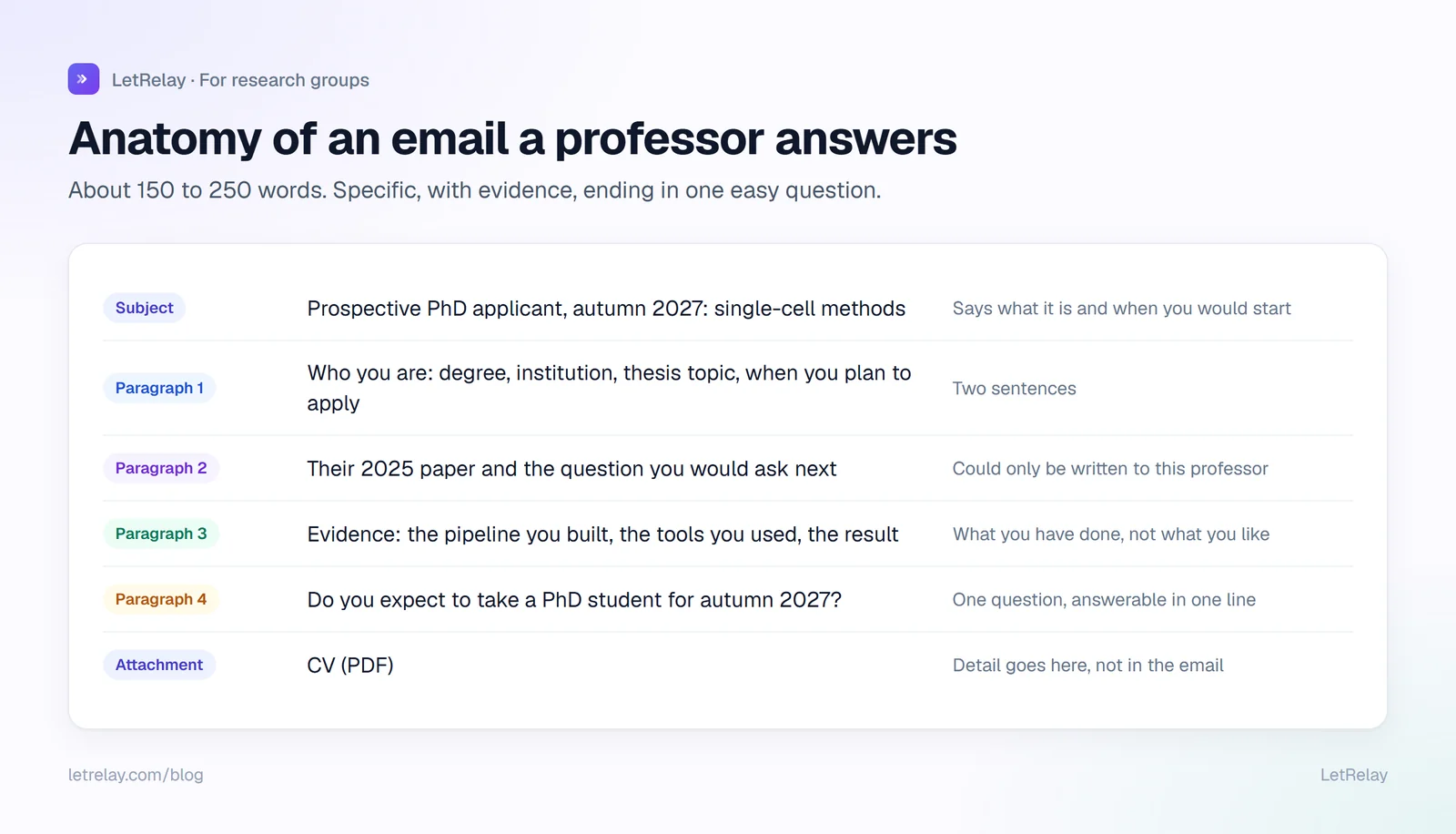
- Specificity. One sentence that could only be written to this professor. Mention a paper from the last two or three years, and what you would ask next, not a compliment.
- Evidence. What you have actually done that makes you likely to succeed: a thesis, a method you can run, a dataset you handled, a tool you built.
- A question that is easy to answer. "Do you expect to take a PhD student for autumn 2027?" can be answered in one line. "What do you think of my research ideas?" cannot.
Example email 1: to a professor who admits to their lab
Subject: Prospective PhD applicant, autumn 2027: single-cell methods

Dear Professor Nakamura,

I am finishing an MSc in Bioinformatics at the University of Lisbon, where
my thesis benchmarks batch-correction methods on single-cell RNA-seq data
from three tissue atlases. I am planning to apply to PhD programs for
autumn 2027.

Your 2025 paper on trajectory inference under batch effects is the reason
I am writing. My thesis found that two widely used correction methods
distort pseudotime ordering in developing tissue, and I would like to work
on inference methods that are robust to this, which seems close to where
your group is heading.

In my MSc I built the full pipeline in Python and R (scanpy, Seurat), ran
it on our university cluster, and I am preparing the results for
submission with my supervisor. My CV is attached.

Do you expect to take a PhD student for autumn 2027? If so, I would be
glad to know whether you would recommend applying through the Genomics
program or the Computational Biology program.

With best regards,
Inês Carvalho
It works because the second paragraph could only have been written to this professor, the third gives evidence, and the last paragraph asks two questions that each need one line to answer.
Example email 2: to a supervisor of an advertised, funded project
Subject: Enquiry: funded PhD "Soil carbon under drought" (ref. ENV-2026-14)

Dear Dr Mensah,

I am interested in the funded PhD project "Soil carbon under drought"
advertised on your department's website, and I would like to ask two
questions before applying.

I hold a BSc in Environmental Science (first class) and an MSc in Earth
System Science, with a dissertation on soil respiration measurements
across a rainfall-exclusion experiment. I have used eddy-covariance and
chamber data and analysed them in R.

1. Is the project open to applicants with international fee status, and
   does the funding cover the full fees?
2. Would you like me to include a short research plan with the
   application, or is the project already fully defined?

My CV is attached. Thank you for your time.

Kind regards,
Daniel Owusu
Include the project reference if there is one; it tells the supervisor instantly which of their inboxes your email belongs in.
Mistakes that get an email deleted
- "Dear Sir/Madam" or the wrong title. Use the name and the title the person uses on their own page.
- The same email to 60 professors. It shows. If you cannot write a specific second paragraph, you are not ready to email that person.
- A long research proposal in the body. Put a one-page summary in an attachment if the program expects one; keep the email short.
- Asking whether you will be admitted. They cannot tell you, and in committee-admission departments they are not allowed to.
- Following up every two days. Once after a week or two, then stop.
When they do not reply
Silence is normal. A PI with a full lab, a grant due and teaching can leave a polite email for weeks. Wait one to two weeks, then send one short follow-up that replies to your first email, so the context is attached. If there is still nothing, apply anyway where contact was optional, and move on where it was required. A non-reply is not a judgement of your application.
Reaching out to a current student in the lab is also fair. They will tell you, often more candidly, whether the professor is taking students and what the lab is like. Keep it short and respect that they owe you nothing. If you are comparing several labs, the questions to ask a potential advisor are a good starting point for that conversation.
For PIs: handling inquiry emails without drowning
Inquiry season arrives in autumn, at the same time as grant deadlines and teaching. A few decisions made once save hours each week.
Put the answer on your lab page. A short "Joining the lab" section answers most emails before they are sent: whether you are recruiting this year, which program(s) students should apply through, what you look for, and whether you reply to inquiries. Applicants who read it write better emails.
Use one reply for most emails. A friendly template ("Thank you for your interest. I expect to take one student for autumn 2027 through the X program; please apply there and mention my name.") is fair and fast. Write a personal reply only to the emails that earn one.
Keep a private recruiting list. Note how many students you can fund, for which year, from which grant, and the applicants who stood out. Keep it private: not visible to your students, and not in a shared lab document.
Be clear about your process. If your department admits by committee, say so. Applicants waste money applying to programs based on an encouraging reply that meant nothing.
How LetRelay does it
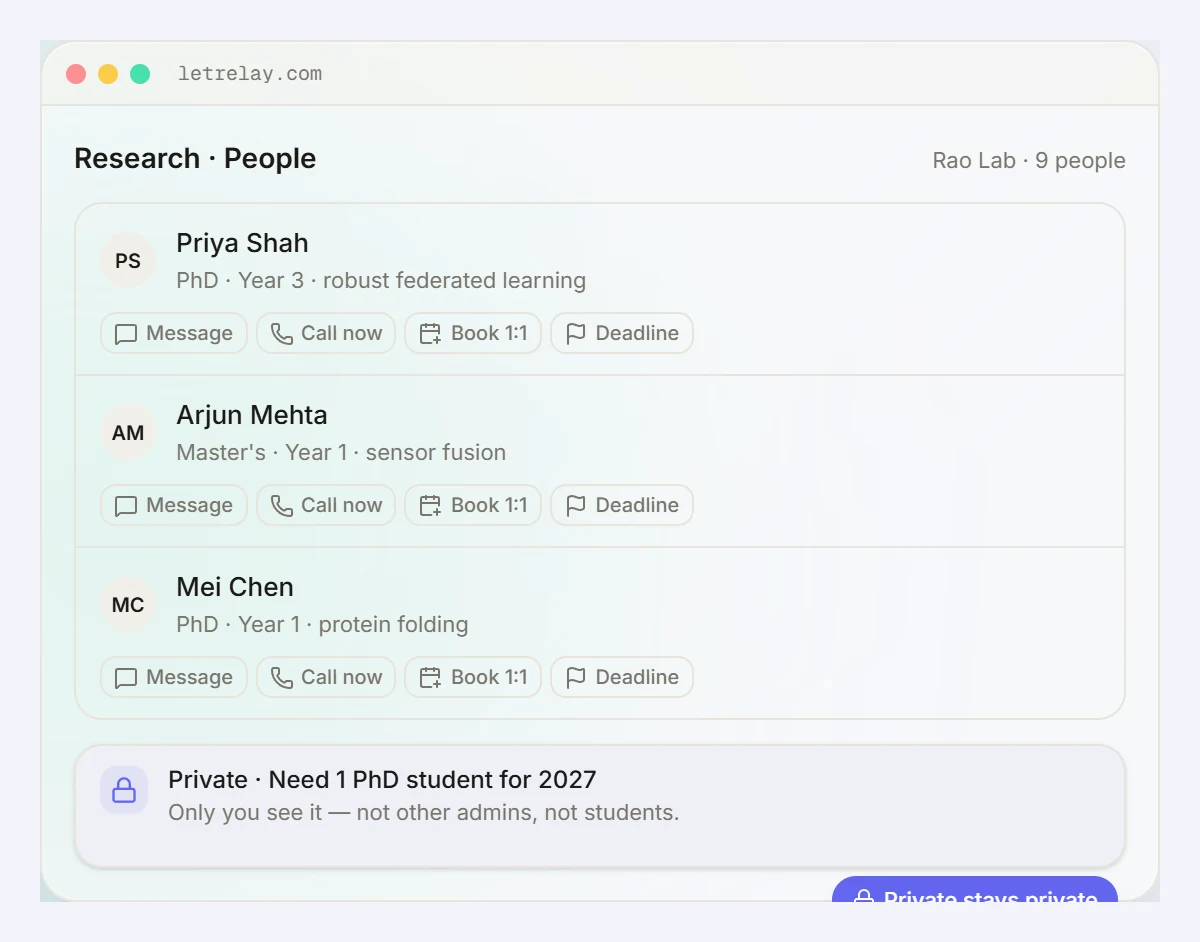
In a LetRelay research group, a PI's Research → Private notes are visible to their author alone: not to other admins, not to supervisors, not to students. It is where "need one PhD student for 2027, funded from the new grant" lives, next to the list of students and their milestones, instead of in a notebook or an email draft. When a new student does join, adding them with their level, start date and supervisor takes one step, and the lab onboarding checklist for new students covers what happens in their first weeks. More on the LetRelay for research groups page.
FAQ
Should I email a professor before applying for a PhD?
Check the department's admissions FAQ first. Some US programs admit by committee and say contact is not needed; others, and most UK and European programs, expect you to contact a potential supervisor, and for self-proposed projects you often cannot apply without one. When contact is expected, email early in the application cycle.
How long should an email to a potential PhD supervisor be?
About 150 to 250 words: four short paragraphs. Put the detail in your attached CV. If the professor wants more, they will ask.
What should I write in the subject line?
What the email is and when you would start: "Prospective PhD applicant, autumn 2027: single-cell methods", or the project title and reference number for an advertised project.
How long should I wait before following up?
One to two weeks. Reply to your original email with two or three lines so the context is included. If there is no answer after that, stop and focus on the application itself.
Should I attach a research proposal?
For a self-proposed project in the UK or Europe, a one to two page summary is often welcome, and sometimes required with the application. For US programs that admit by committee, a CV is enough; save the research ideas for your statement of purpose.
Is it okay to email current PhD students in the lab?
Yes, briefly and politely. Ask one or two specific questions, such as whether the professor is recruiting and how supervision works in the lab. Students are often the most honest source you have.
Sources
Building LetRelay, the workspace for research groups and small teams: lab management, supervision tools, and an internal request desk with AI triage and SLA tracking.
Run your internal requests on LetRelay
AI triage, SLA-tracked queues, and bottleneck analytics — the help desk your team actually likes. Free to start.
Keep reading
How to Ask a Professor for a Recommendation Letter
When to ask, what to send, and the exact emails to use, plus how professors can handle a stack of letter requests without missing a deadline.
Lab Onboarding Checklist for New PhD Students and Members
A lab onboarding checklist for the first day, first week and first month of a new PhD student, postdoc or visiting researcher, plus the offboarding list that keeps data and keys from walking out the door.
PhD Weekly Update Template (With Real Examples)
A weekly update a PhD student can write in three minutes and a supervisor can read in thirty seconds. The template, good and bad examples, versions for each stage of the degree, and how supervisors should answer.