Choosing a PhD Advisor: Questions to Ask and Red Flags
The questions to ask a potential PhD advisor and their students, the red flags that matter, what the data says about supervision, and how to change advisor.
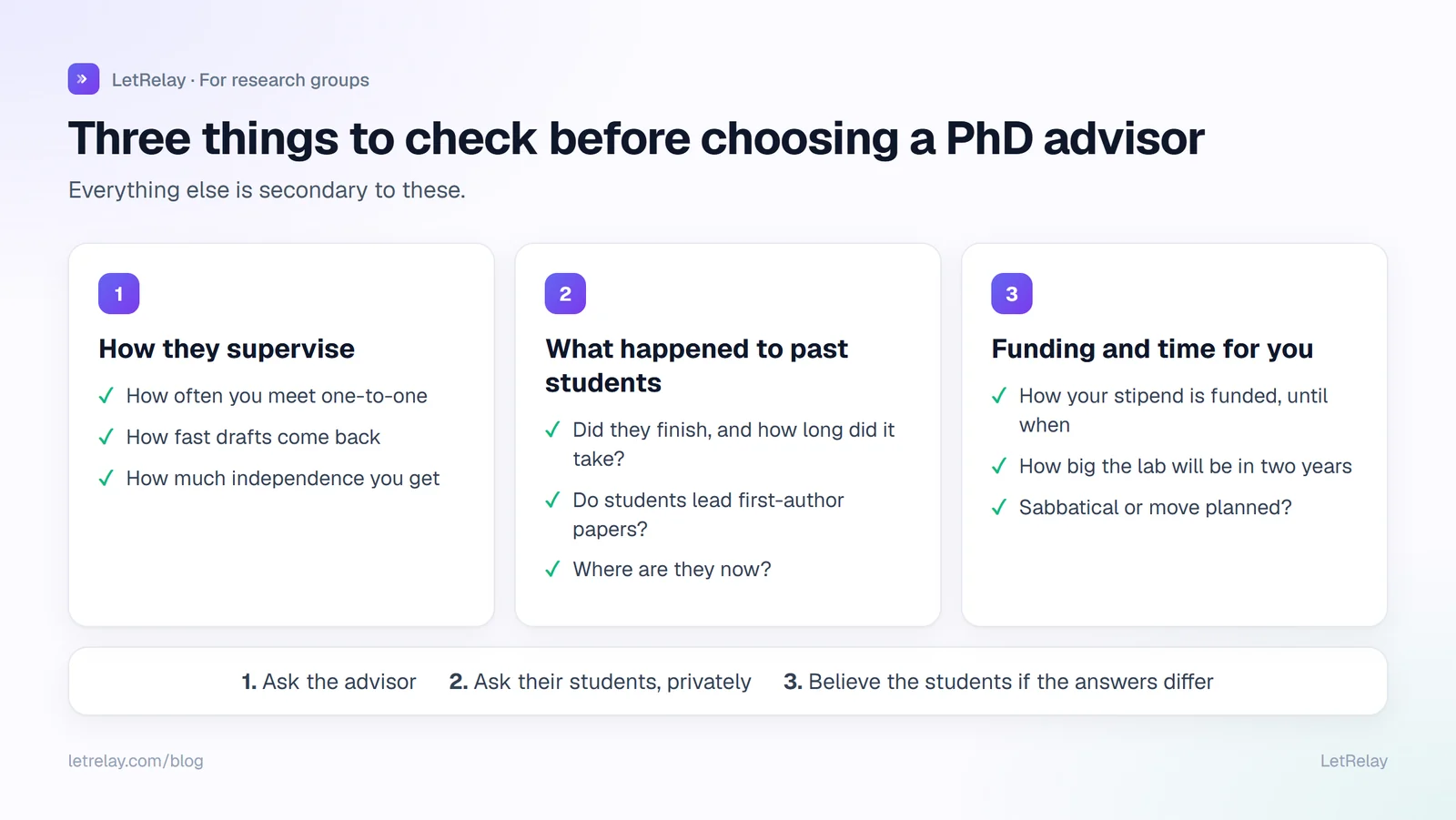
The questions to ask a potential PhD advisor come down to three things you can actually check: how they supervise (how often you will meet, how they give feedback, how much independence you get), what has happened to their past students (did they finish, how long did it take, where are they now), and whether the lab has money and time for you. Ask the advisor directly, then ask their students privately, and believe the students if the answers differ.
The choice matters more than almost anything else in a PhD. When Nature's 2025 global survey asked more than 3,700 doctoral students what advice they would give someone considering a PhD, the most common answer was to find the right supervisor. Below: the questions to ask, what to verify yourself, the red flags worth walking away over, and what to do if you are already in the wrong lab.
Why the advisor matters more than the project
A project can change. The person you report to for five years usually does not. Supervision also shows up directly in how students feel about their PhD. In Nature's 2025 survey, about half of respondents said their supervisor spent less than an hour a week with them; 69% of that group were at least moderately satisfied with their PhD, compared with around 82% of students who met their supervisor more often.
And not every PhD ends with a degree. The Council of Graduate Schools' PhD Completion Project, which followed cohorts that started between 1992 and 2004 at US and Canadian universities, found that 57% had completed within ten years. Some of the difference between students who finish and students who leave is funding, some is the field, and some is supervision. You can find out a lot about the last one before you commit.
Questions to ask the advisor
You will not have time for all of these. Pick the ones that matter most to you and ask them in a real conversation, not as a checklist read aloud.
| Topic | Question |
|---|---|
| Supervision | How often do you meet one-to-one with students, and who schedules it? |
| Supervision | How do you like to receive updates between meetings? |
| Feedback | How long does it usually take you to return comments on a draft? |
| Independence | Would I choose my project, or join an existing one? How much can it change? |
| Independence | What happens if my main experiment or approach does not work in year two? |
| Funding | How is my stipend funded, and for how many years is it secured? |
| Funding | Who pays for conferences, equipment, compute or sequencing? |
| Publishing | How do you decide authorship? Do students usually publish first-author papers? |
| Time to degree | How long did your last few students take to finish? |
| Careers | Where are your former students now? Do you support careers outside academia? |
| Lab | How big is the lab likely to be in two years? Will you be on sabbatical or moving? |
| Culture | What are your expectations about working hours and holidays? |
| Conflict | How do you handle it when a student is struggling, academically or personally? |
The answers to the last two tell you a great deal. A clear, relaxed answer is a good sign. Vague discomfort is worth noting.
Questions to ask current and former students
Current students are the best source you have, but they are cautious; their advisor still controls their funding and their letters. Former students have less to lose. Ask to speak to students without the advisor present, and keep your questions concrete:
- How often do you actually meet with them, one-to-one?
- When did you last get feedback on a draft, and how long did it take?
- What happens when an experiment fails for months?
- Does anyone in the lab work nights and weekends because they feel they have to?
- Has anyone left the lab or the program in the last few years? Do you know why?
- Would you choose this lab again?
Listen to what is not said. "They're very busy" repeated three times is an answer.
Check what you can verify yourself
Some of the most important facts are public:
- Publications with student first authors. Look at the last five years. Do students, especially senior ones, lead papers?
- Alumni outcomes. Lab websites often list former members. Look them up. Where did they go, and how long did they stay in the lab?
- Time to degree. Look at thesis dates in your university's repository against the start years on alumni profiles.
- Funding. Grant databases (for example NIH RePORTER in the US, or the relevant national funder elsewhere) show active awards and end dates.
Ben Barres, the Stanford neurobiologist, argued in his 2013 Neuron essay "How to pick a graduate advisor" that the best measure of a mentor is how their trainees do. He even proposed an index for it. You do not need a formula; you need the list of trainees and a search engine.
Red flags, and what they usually mean
| Red flag | Why it matters |
|---|---|
| Several students left without finishing, and nobody will say why | A pattern, not bad luck |
| Senior students have no first-author papers | Students may not be supported to publish |
| "I meet students whenever they need me" but students say they cannot get time | Supervision depends on chasing |
| Very long time to degree across the lab | Projects are not scoped, or students are kept for labour |
| No clear answer about funding beyond this year | You may be funding-limited later |
| Students describe fear: of asking, of taking holidays, of failed experiments | The culture will not change for you |
| The advisor speaks badly about former students | You will be the next story |
| Pressure to commit before you have talked to students | They know what the students would say |
Bullying is not rare. In Nature's 2019 survey of about 6,300 PhD students, 21% said they had been bullied, and 48% of those named their supervisor as the perpetrator. The 2025 survey found that about 43% of respondents had experienced some form of discrimination or harassment; in around four in ten bullying cases the supervisor was the person involved, and only 28% of those students felt able to report it without fear of reprisal. Take the culture questions seriously.
Green flags
Good signs are just as specific:
- A regular, protected meeting rhythm, and students confirm it happens.
- Written expectations: a lab handbook or lab expectations document that covers hours, authorship, holidays and communication.
- Students who talk about their own ideas, not only the advisor's.
- Alumni in a range of careers, all still in touch with the lab.
- The advisor asks you what you want, and what support you need.
If you are already in the wrong lab
Changing advisor mid-PhD is less rare than it feels, and it can be done without burning bridges. A September 2026 Nature careers article on exactly this situation collected advice from ombudspersons, counsellors and graduate leaders. The practical steps:
- Get clear on the reason. Scientific mismatch, working style, or conflict? The answer changes the approach.
- Start with a confidential conversation. Most universities have an ombudsperson or a similar person of trust, and graduate program directors handle this regularly.
- Consider a softer change first. A co-supervisor, or moving labs while keeping your current advisor on your committee.
- Talk to potential new advisors discreetly before telling your current one. Funding is often the deciding factor; a new lab needs to be able to support you if your funding does not transfer.
- Be realistic about time. Moving can extend your PhD if your work does not transfer. If you are close to the end, agreeing a defined body of work to finish may be the better route.
- Have the conversation thoughtfully and honestly, centred on what you both want to happen next.
For PIs: how to be the advisor students choose
Good students ask these questions. The labs that answer them in writing, before being asked, attract more of them.
- Publish a short expectations document: meeting rhythm, feedback turnaround, hours, holidays, authorship.
- List alumni and where they are now on your lab page.
- Let prospective students talk to your current students without you in the room.
- Keep the promise you make about meetings. Nature's 2025 editorial made the point that even short, regular check-ins make a difference. A 1:1 supervision agenda keeps them useful, and running a group without chasing students keeps them from turning into status reports.
How LetRelay does it
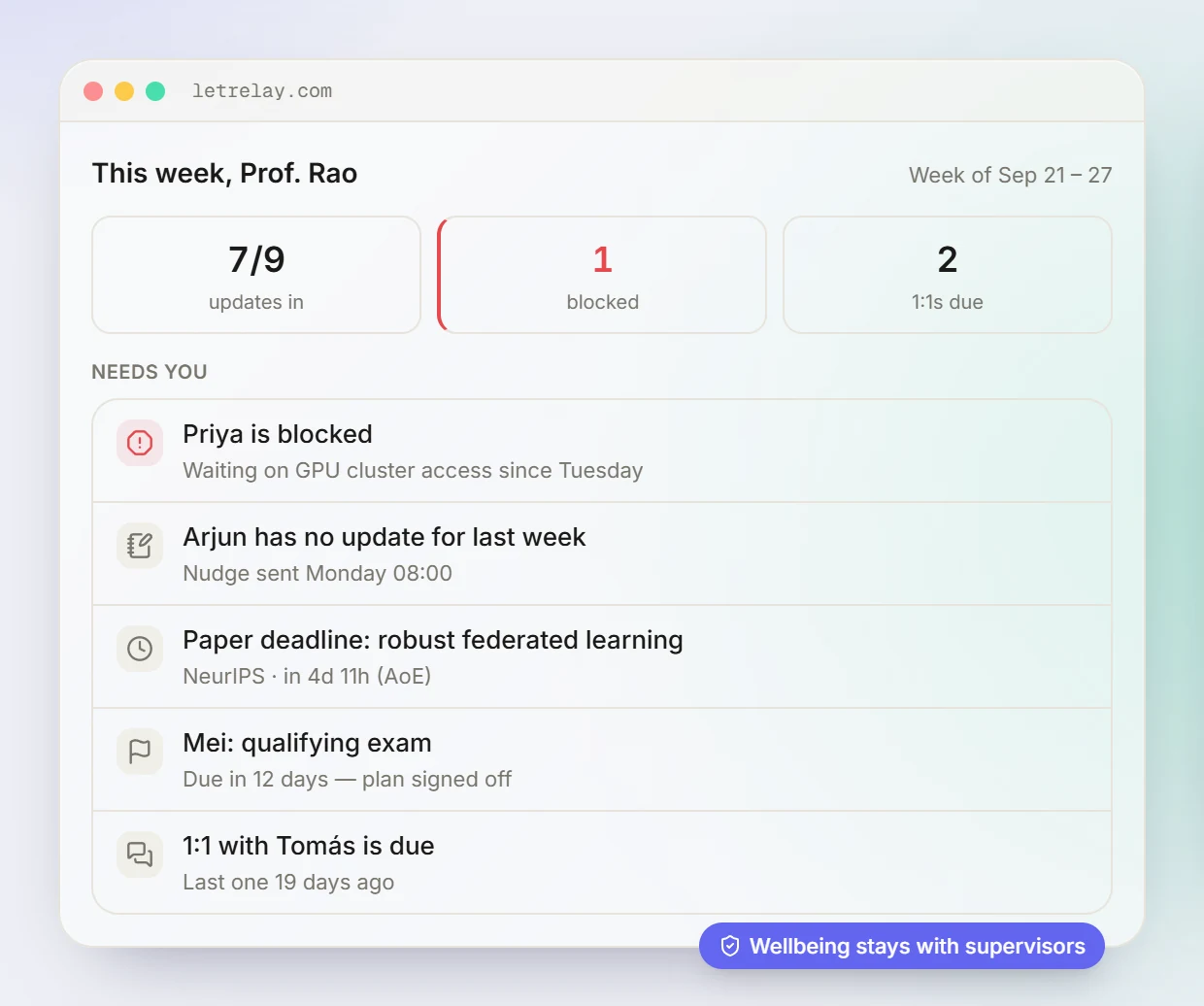
LetRelay gives a research group the structure prospective students should be asking about. Students write a three-minute update each Friday; the supervisor gets a Monday digest with blockers first; a student who has not had a 1:1 in a while is flagged as overdue; and milestones remind both the student and the supervisor before they are due. Students can add a wellbeing score that only their supervisors see. It turns "I meet students whenever they need me" into something that actually happens. More on the LetRelay for research groups page.
FAQ
What questions should I ask a potential PhD advisor?
Ask how often you will meet, how quickly they give feedback, how independent your project would be, how your stipend is funded and for how long, how authorship is decided, how long their recent students took to finish, and where those students are now. Then ask their students the same questions privately.
What are red flags in a PhD advisor?
A pattern of students leaving without finishing, senior students without first-author papers, very long times to degree, unclear funding, students who describe fear of asking questions or taking time off, and an advisor who speaks badly about former students.
Should I choose a famous advisor or a supportive one?
If you have to choose, choose the one whose students do well. A well-known name helps with letters and networks, but only if you have the supervision to produce good work. Check what happened to both advisors' recent students.
How do I find out what an advisor is really like?
Talk to current students without the advisor present, and to former students who have already graduated. Check first-author publications by students and where alumni went. Former students are usually the most candid.
Can you change your PhD advisor?
Yes. Start with a confidential conversation with your program director or ombudsperson, consider a co-supervisor or keeping your current advisor on your committee, and secure funding in the new lab before the move. Expect it may add time if your work does not transfer.
Sources
- Nature editorial (2025): What makes PhD students happy? Good supervision
- Nature careers (2026): How do I change labs gracefully during my PhD?
- Inside Higher Ed: PhD student poll finds mental health, bullying and career uncertainty are top concerns (Nature 2019 survey)
- Council of Graduate Schools: Ph.D. Completion and Attrition, analysis of baseline demographic data from the Ph.D. Completion Project (PDF)
- Barres, B. A. (2013). How to pick a graduate advisor. Neuron 80(2), 275-279
Building LetRelay, the workspace for research groups and small teams: lab management, supervision tools, and an internal request desk with AI triage and SLA tracking.
Run your internal requests on LetRelay
AI triage, SLA-tracked queues, and bottleneck analytics — the help desk your team actually likes. Free to start.
Keep reading
How to Write a Recommendation Letter for a Graduate Student
A paragraph-by-paragraph structure, an example letter, the phrases that quietly weaken a letter, and a workflow for PIs writing dozens each season.
How to Email a Potential PhD Supervisor (With Examples)
When emailing a professor helps your PhD application and when it does not, what to write, two example emails, and how PIs can handle inquiries fairly.
PhD Weekly Update Template (With Real Examples)
A weekly update a PhD student can write in three minutes and a supervisor can read in thirty seconds. The template, good and bad examples, versions for each stage of the degree, and how supervisors should answer.