Lab Expectations Document: What to Include (Template)
What a lab expectations document covers, a copyable template for PIs, real examples from published lab manuals, and how students and lab managers use it.
A lab expectations document is a short written agreement, usually two to four pages, that says how your lab works: how often you meet and how people communicate, working hours and time off, how progress is reported, how authorship and data are handled, what everyone does to keep the lab running, and what the PI commits to in return. You write it once, go through it with every new member, and revise it each year.
Most lab conflicts are not about science. They are about unspoken assumptions: whether weekends are expected, how fast emails should be answered, who decides authorship. A written document turns those assumptions into something people can read before they join and point to when there is a disagreement. Below: what to include, a template you can copy, examples from real published lab manuals, and how students and lab managers get the most out of it.
Why write it down
Kristyn Masters and Pamela Kreeger's "Ten simple rules for developing a mentor–mentee expectations document" (PLOS Computational Biology, 2017) makes the case clearly. Their first rule is simply to write it down: a written document communicates expectations more clearly and consistently than conversations, and written expectations reduce the potential for conflicts and misunderstandings that damage both the mentor's and the mentee's productivity and happiness.
It also helps recruiting. Prospective students who ask the right questions (see our guide on choosing a PhD advisor) get their answers in writing before they commit, and the students who choose your lab know what they are signing up for.
Expectations document, lab manual, compact, SOP: what is the difference?
The names overlap and labs use them loosely. A useful way to separate them:
| Document | What it covers | Who writes it | Length |
|---|---|---|---|
| Expectations document | How the lab works: meetings, hours, communication, authorship, commitments on both sides | PI, with lab input | 2 to 4 pages |
| Lab manual or handbook | Everything a member needs to know: expectations plus practical how-tos, contacts, onboarding | PI and lab manager | 10 to 50 pages, often online |
| Mentoring compact | A mutual agreement between one mentor and one mentee, often signed | Institution provides a model, pair adapts it | 2 to 6 pages |
| SOPs | Step-by-step procedures for equipment, protocols and safety | Lab manager and experienced members | One per procedure |
Many labs start with the expectations document and grow it into a manual. In biomedical sciences, the AAMC's Compact Between Biomedical Graduate Students and Their Research Advisors is a widely used model for the mutual commitments part; a companion compact covers postdocs and their mentors.
What to include
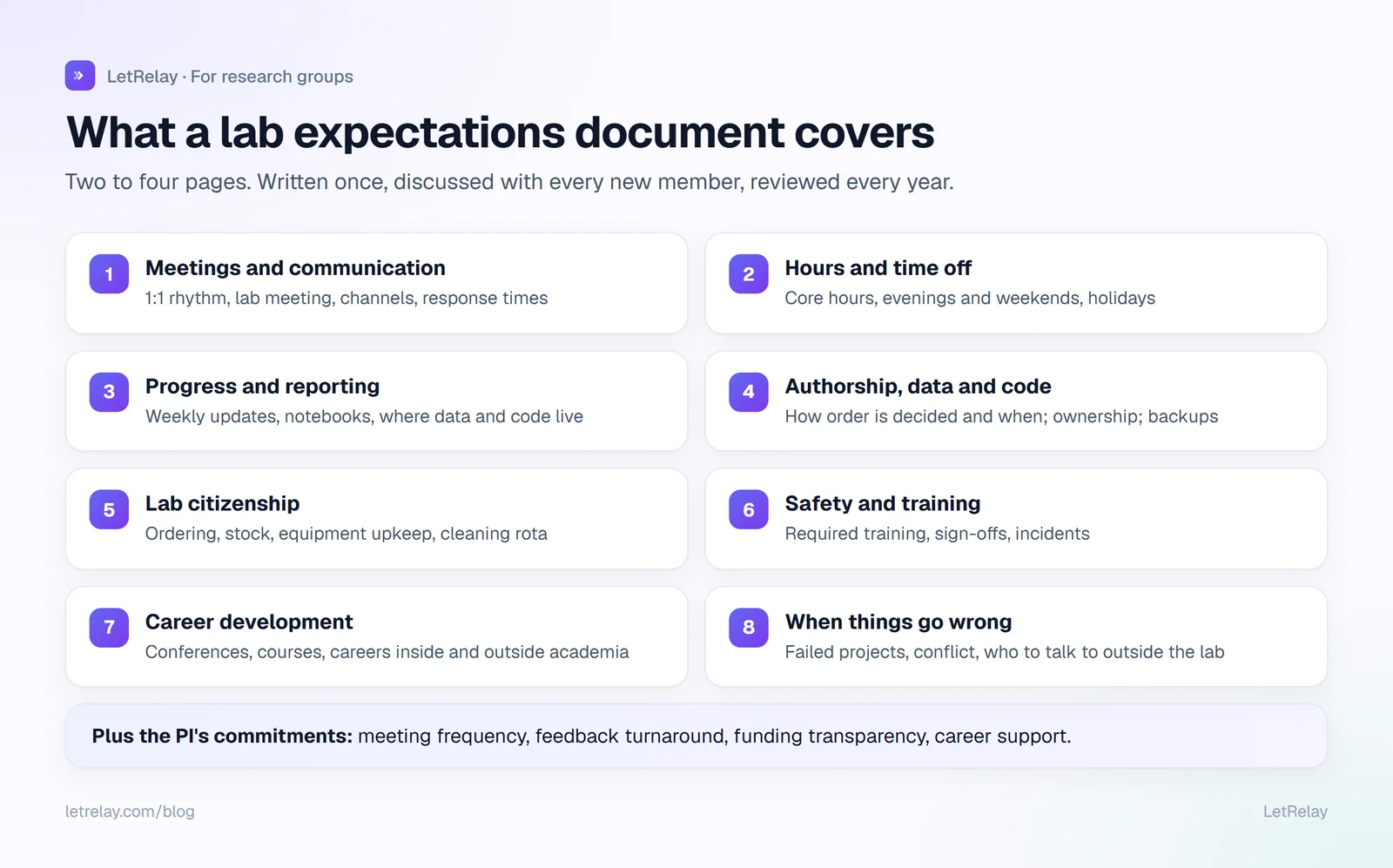
1. Meetings and communication. How often each person meets the PI one-to-one, lab meeting format and attendance, which channel is used for what (chat for quick questions, email for decisions), and expected response times in both directions.
2. Hours, holidays and time off. Core hours if any, whether evenings and weekends are expected (say so either way), how holidays are requested, and the rules your institution or funder sets.
3. Progress and reporting. Weekly written updates, notebook standards, where data and code live, when drafts are due before deadlines. If you use a weekly update format, link it; ours is in the PhD weekly update template.
4. Authorship, data and code. How authorship order is decided and when it is discussed, who owns data, where it is stored, what must be backed up, and how code is shared.
5. Lab citizenship. Shared duties: ordering, stock checks, equipment upkeep, cleaning rota, training new members. Name the rota, do not just mention "helping out". A shared lab inventory makes the stock-check rota easy to keep.
6. Safety and training. Required institutional training, equipment certification, who signs people off, and what to do in an incident.
7. Career development. How the PI supports conferences, courses, internships and careers outside academia; how often career goals are discussed (for many trainees, through an individual development plan).
8. When things go wrong. What to do when an experiment fails for months, when there is a conflict in the lab, or when a member is struggling. Name people outside the lab too: graduate program director, ombudsperson, wellbeing services.
And the PI's commitments. Masters and Kreeger's fifth rule is that expectations are a two-way street. State what members can expect from you: meeting frequency, feedback turnaround on drafts, funding transparency, and support for their careers.
A template you can copy
Edit the bracketed parts. Delete what does not apply; add what is unique to your lab.
[Lab name] expectations
Last reviewed: [date]. We review this together every [September].

WHAT YOU CAN EXPECT FROM ME (the PI)
- A one-to-one meeting every [week / two weeks], which I will not cancel
  without offering another time.
- Comments on drafts within [5 working days]; within [2] if a deadline
  is less than two weeks away.
- Honest information about funding: how you are funded and until when.
- Support for your career, inside or outside academia, including
  [one conference per year] and time for courses.

WHAT WE EXPECT FROM EACH OTHER
Meetings
- Lab meeting: [Wednesdays 13:30]. Attendance expected unless you are
  away, ill, or at an experiment that cannot move.
- Bring an agenda to 1:1s. Send notes and agreed actions afterwards.
Communication
- Quick questions: [lab chat]. Decisions and anything with a date: email.
- Replies within [2 working days]. Nobody is expected to reply in the
  evening or at weekends.
Hours and time off
- [We work roughly normal working hours. Evenings and weekends are not
  expected, except when an experiment requires it.]
- Holidays: tell the lab [2 weeks] ahead and add them to the shared
  calendar. [X] days per year following [institution policy].
Progress
- A short written update every Friday: done, next, blockers, reading.
- Data and code in [shared drive / repository], never only on a laptop.
Authorship
- We discuss authorship at the start of every paper and revisit it when
  the project changes. [Contribution guidelines, e.g. CRediT roles.]
Lab citizenship
- Everyone is on the [ordering / stock / equipment] rota.
- Book shared equipment in [system] and respect the booking limits.
Safety
- Complete [institutional training] before working in the lab.
  Equipment sign-off from [lab manager] before first use.
When things go wrong
- Tell me early. A problem raised in week one is small.
- If you cannot raise something with me, talk to [program director /
  ombudsperson / named colleague].
For the "Book shared equipment" line, fair equipment booking rules show what to put in the brackets (booking limits, no-show rules, who signs people off).
What real labs write
Published lab manuals are worth reading before you write your own; Masters and Kreeger's eighth rule is that borrowing is fine. Many are on GitHub. The Fay Lab at UMass Dartmouth's School for Marine Science and Technology, for example, states plainly that full time is enough and that the team is not expected to work nights and weekends, commits the PI to regular one-to-one meetings, and asks lab members to come to meetings with an agenda. Short, specific sentences like these do more than a page of values.
Rolling it out
- Draft it yourself, then share it with the lab for comments before it is final. Rule seven: work with others to develop it.
- Go through it one-to-one with every new member in their first week, as part of your lab onboarding checklist. Ask what they would change.
- Put it where people will find it: the lab's knowledge base or handbook, not an email attachment.
- Review it every year with the whole lab. Rule ten: it is a living document.
- Use it when something goes wrong. "Our document says drafts are due two weeks before the deadline" is a calmer conversation than one based on memory.
For students and postdocs: how to use it
Ask for it before you join a lab. If there is none, ask the questions it would answer; the answers tell you how the lab really runs. Once you have joined, read it properly, and raise anything that does not work for you in your first month, not your third year. If your situation changes (a health issue, a family move, a funding gap), the document is the starting point for renegotiating, not the end of the conversation.
For lab managers
The practical sections are yours: ordering, stock, equipment booking, training sign-off, the duty rota and safety. Keep them short in the expectations document and link out to the detailed procedures. When a new member starts, the expectations document is the first thing they read, and your operational pages are the second.
How LetRelay does it
In LetRelay, a research group keeps its expectations document and SOPs in the workspace's knowledge base, next to the onboarding checklist every new member works through. The routines the document describes are built in: Friday updates and a Monday digest, 1:1 notes that turn into tasks, a shared calendar for holidays and lab meetings, a duty roster, and equipment booking with per-resource limits. Privacy rules are enforced in the database: students never see each other's updates or 1:1 notes. More on the LetRelay for research groups page.
FAQ
What should a lab expectations document include?
Meetings and communication, working hours and time off, how progress is reported, authorship and data, shared lab duties, safety and training, career development, what to do when things go wrong, and what the PI commits to in return.
How long should a lab expectations document be?
Two to four pages is enough for the expectations themselves. Practical detail such as ordering procedures and SOPs belongs in a longer lab manual, linked from the document.
Is a lab expectations document the same as a mentoring compact?
Not quite. A compact is usually an agreement between one mentor and one mentee, often based on an institutional model such as the AAMC compacts. An expectations document covers the whole lab. Many PIs use both.
Should students sign the lab expectations document?
Signing is optional. What matters is that each new member reads it and discusses it with the PI in their first weeks. Some labs record that conversation in the member's onboarding checklist.
How often should a lab expectations document be updated?
Once a year, with the whole lab, and whenever something changes, such as a new funder rule, a move, or a lesson learned from a conflict.
Sources
- Masters, K. S. and Kreeger, P. K. (2017). Ten simple rules for developing a mentor–mentee expectations document. PLOS Computational Biology 13(9)
- AAMC: Compact Between Biomedical Graduate Students and Their Research Advisors
- AAMC: Compact Between Postdoctoral Appointees and Their Mentors
- Fay Lab Manual, UMass Dartmouth SMAST: Expectations
Building LetRelay, the workspace for research groups and small teams: lab management, supervision tools, and an internal request desk with AI triage and SLA tracking.
Run your internal requests on LetRelay
AI triage, SLA-tracked queues, and bottleneck analytics — the help desk your team actually likes. Free to start.
Keep reading
Lab Inventory Management: Spreadsheet Template and Tools
The columns a lab inventory spreadsheet needs, how to set reorder levels, a simple ordering workflow, and when to move to free or paid inventory software.
How to Write a Recommendation Letter for a Graduate Student
A paragraph-by-paragraph structure, an example letter, the phrases that quietly weaken a letter, and a workflow for PIs writing dozens each season.
How to Email a Potential PhD Supervisor (With Examples)
When emailing a professor helps your PhD application and when it does not, what to write, two example emails, and how PIs can handle inquiries fairly.