How to Write a Recommendation Letter for a Graduate Student
A paragraph-by-paragraph structure, an example letter, the phrases that quietly weaken a letter, and a workflow for PIs writing dozens each season.
To write a strong recommendation letter for a graduate student, keep it to about one page: say how you know the student and for how long, give two or three specific examples of their work with enough detail to be believed, compare them honestly with other students you have supervised, and end with an endorsement nobody could misread. What weakens letters is rarely criticism. It is vagueness, faint praise, and details that have nothing to do with the student's work.
This guide is for professors, postdocs and anyone else asked to write for a student applying to grad school, whether a master's or a PhD program. It covers the structure, an example, the language research has found hurts candidates, and how to keep up when letter season brings twenty requests in a month.
Before you say yes
Ask yourself one question: can I write a strong letter? If you only know the student's grade, or if what you would honestly write is lukewarm, say so now. A week into the request, the student can still find someone else. On the day before the deadline, they cannot.
A good way to put it: "I don't think I know your work well enough to write the strong letter you deserve. Dr X supervised your project and would be a better choice." It is kind, and it is true.
If you do say yes, ask for the same packet every time: CV, statement draft, list of programs with deadlines and submission links, and a short summary of the work you did together. Our guide on how to ask a professor for a recommendation letter is written for students; sending them the link saves you the explanation.
The structure, paragraph by paragraph
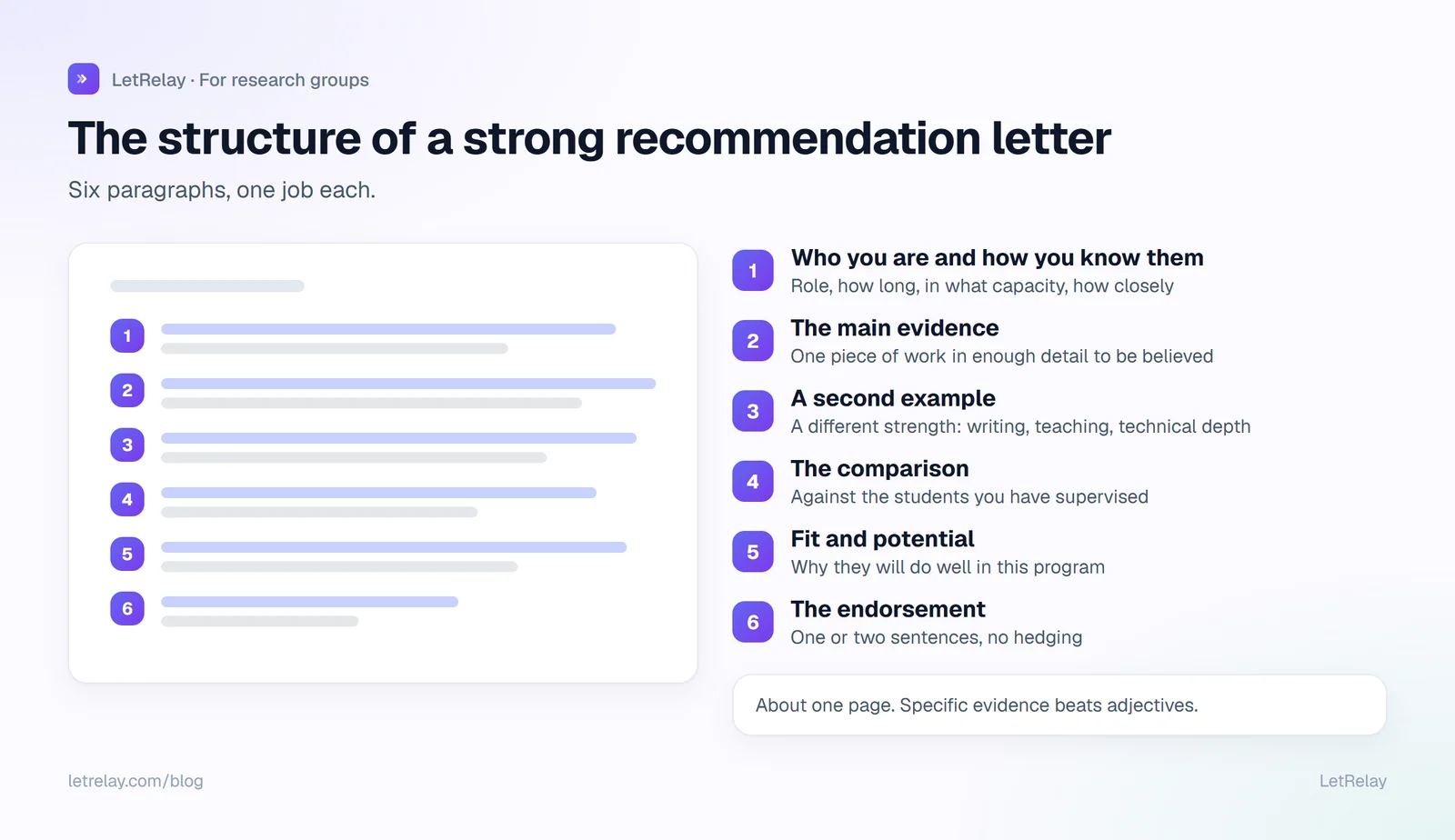
1. Who you are and how you know the student. Your role, how long you have known them, in what capacity, and how closely. "I supervised Amara's summer research project in my lab from June to September 2026, meeting with her weekly" tells the committee how much weight to give everything that follows.
2. The main evidence: what they did. One concrete piece of work described in enough detail that a reader in the field can judge it. Not "she did excellent research" but what the problem was, what she did, what went wrong, and what she did about it.
3. A second example, showing a different strength. If paragraph 2 was about independent problem-solving, make this about writing, teaching, collaboration or technical depth. Committees read for range.
4. The comparison. Place the student against the people you have taught or supervised: "Of the roughly 60 students who have worked in my lab over twelve years, Amara is among the top five in her ability to design an experiment without being told what to do." Comparisons are among the most useful sentences in a letter, because they are hard to fake. Make sure they match any rating grid the application portal asks you to fill in; a "top 5%" tick box next to a paragraph of mild praise reads as a contradiction.
5. Fit and potential. Why this student will do well in this kind of program, and, if you know the program, in this one specifically.
6. The endorsement. One or two sentences, without hedging: "I recommend her for your PhD program without reservation." Offer to answer questions and give your contact details.
An example letter
This example is invented, but it follows the structure above. It is about 400 words; most strong letters land between one and one and a half pages.
Dear Members of the Admissions Committee,

I am writing to recommend Amara Chen for admission to your PhD program in
Computational Biology. I am an associate professor of genomics at [University]
and supervised Amara's summer research project in my lab from June to
September 2026. We met weekly, and she worked alongside two of my PhD students
every day.

Amara joined a project that had stalled: our single-cell pipeline produced
different cell-type assignments each time it ran on the same data. Within
three weeks she traced the problem to a random seed that was not being passed
to one clustering step, fixed it, and then wrote tests so it could not happen
again. What impressed me was not the fix itself but that she found it by
designing her own experiment: she ran the pipeline 50 times, logged every
intermediate result, and compared them systematically.

She is also an unusually clear writer. Her end-of-project report is now the
document we give new students to understand the pipeline. When our visiting
undergraduates struggled with the command line, she ran two afternoon
sessions for them without being asked.

I have supervised about 60 students in my lab over twelve years. Amara is
among the top five in her ability to work independently on an unfamiliar
problem, and among the top ten overall.

She is ready for a PhD. She has the technical skill, and more importantly
she knows how to find out why something does not work. Your program's
emphasis on method development suits her well.

I recommend Amara to your program without reservation, and I would be glad
to answer any questions.

Sincerely,
[Name, title, institution, email]
Language that quietly weakens a letter
Research on real letters has found the same patterns again and again. The best-known study, by Frances Trix and Carolyn Psenka (2003), analysed 312 letters written for successful applicants to faculty positions at a large American medical school. Letters for women differed systematically from letters for men: in the extremes of length, in how often they lacked basic features, and in how often they contained what the authors called "doubt raisers", an extended category of negative language, hedges, unexplained comments, faint praise and irrelevancies. The authors also noted that letters for women leaned on "grindstone" adjectives such as hardworking, while standout adjectives such as superb, outstanding and remarkable appeared more often in letters for men.
A later pair of studies by Madera, Hebl and Martin (2009) found that women were described in more communal and less agentic terms, and that communal descriptions were negatively related to hiring decisions based on the letters.
You do not need to have biased intentions to write a biased letter. A checklist catches most of it:
| Check | Instead of | Write |
|---|---|---|
| No faint praise | "She did everything that was asked of her" | What she did that nobody asked for |
| No hedges | "He may become a good researcher" | What he has already done as a researcher |
| No irrelevancies | Personality, appearance, family, "a pleasure to have in class" | Their work, skills and results |
| Achievements first | "Hardworking and diligent" | "Designed the experiment that..." |
| Standout words, with evidence | "Excellent" with nothing behind it | "Excellent: her analysis changed our paper's main result" |
| Same length for everyone | A short letter for a student you rate highly | Equal effort for equally strong students |
| Titles and names | First name for some students, full name for others | Consistent across all your letters |
Read your finished letter once with this table next to it, and once more imagining the same letter written about a student of a different gender. If a sentence would sound odd about the other student, rewrite it.
Tailor to what the reader is choosing
PhD admissions want to know whether the student can do independent research. Lead with the research, and write about how they handle problems and setbacks.
Master's programs care more about preparation, academic strength and motivation. Course performance and a substantial project carry more weight here.
Fellowships often publish the criteria recommenders should address. Use their words as your paragraph topics; reviewers score against them.
Industry roles want to know about reliability, collaboration and technical skill in a working context. Keep academic detail short.
If a student applies to several kinds of program, keep one master letter and adjust the fit paragraph and the emphasis. Most of the letter stays the same.
When you cannot write a strong letter but you already agreed
It happens: you agreed quickly, then realised you have little to say. Tell the student as soon as you know, and offer to write a factual letter or to help them find someone better placed. Do not submit a thin letter without warning them. Committees read "letters of minimal assurance", as Trix and Psenka called them, as a warning.
For PIs: a workflow for letter season
A PI with a large group can write forty letters between October and January. The writing is the easy part; keeping track is what fails.
- One list, sorted by deadline: student, program, deadline, submission method, status. Not a folder of emails.
- One master letter per student, stored with their record, updated each year with new results. Next year's letter starts from this year's.
- Portals first. Portal links arrive by email from the application system, often weeks before you write. Keep them with the list so you are not searching your inbox on the due date.
- Block writing time in the first week of November and the first week of December. Most letters can be written in a few focused sessions.
- Confirm submission to the student. One line stops the reminder emails.
- Ask students for a short update each autumn, even if they are not applying. It keeps your memory of their work fresh for the year they do, and a habit of weekly updates builds that record all year without extra effort.
How LetRelay does it
In a LetRelay research group, students request recommendation letters with the deadline and materials attached, and the PI works them as a queue sorted by due date. Because the lab's record already holds each student's milestones, papers, 1:1 notes and weekly updates, the evidence for paragraphs 2 and 3 is one click away, not buried in last year's email. The same record drafts each student's annual progress report. More on the LetRelay for research groups page.
FAQ
How long should a recommendation letter for graduate school be?
Usually one to one and a half pages, roughly 400 to 700 words. Length is read as a signal of effort and enthusiasm, so a strong student should not get a short letter. Very long letters are rarely needed; specific evidence matters more than volume.
Should I let the student draft their own recommendation letter?
It is better not to. A letter drafted by the applicant tends to read like their own statement, and it defeats the point of a confidential letter. Ask the student for a summary of facts instead: what they did, when, and the results. Then write the letter in your own words.
Should a recommendation letter mention weaknesses?
Only if it is relevant and you describe what the student did about it. "Her first draft was hard to follow; by the third she was writing sections our paper now uses" is useful. An unexplained criticism is a doubt raiser and will be read as a warning.
How do I address a recommendation letter when I do not know the recipient?
"Dear Members of the Admissions Committee" works for graduate programs. For fellowships or jobs, use the committee or panel name given in the call.
Can I reuse the same recommendation letter for different programs?
Yes, with a tailored fit paragraph, and with the program name correct in every copy. Programs of the same type can usually receive the same letter.
What if I agreed to write a letter and cannot make the deadline?
Tell the student and the program as early as you can. Many programs can wait a few days for a letter that is on its way; they cannot help if nobody tells them.
Sources
- Trix, F. and Psenka, C. (2003). Exploring the color of glass: letters of recommendation for female and male medical faculty. Discourse & Society 14(2)
- Madera, J. M., Hebl, M. R. and Martin, R. C. (2009). Gender and letters of recommendation for academia: agentic and communal differences. Journal of Applied Psychology (PDF)
- University of Arizona Commission on the Status of Women: Avoiding gender bias in reference writing (via AAR)
Building LetRelay, the workspace for research groups and small teams: lab management, supervision tools, and an internal request desk with AI triage and SLA tracking.
Run your internal requests on LetRelay
AI triage, SLA-tracked queues, and bottleneck analytics — the help desk your team actually likes. Free to start.
Keep reading
How to Email a Potential PhD Supervisor (With Examples)
When emailing a professor helps your PhD application and when it does not, what to write, two example emails, and how PIs can handle inquiries fairly.
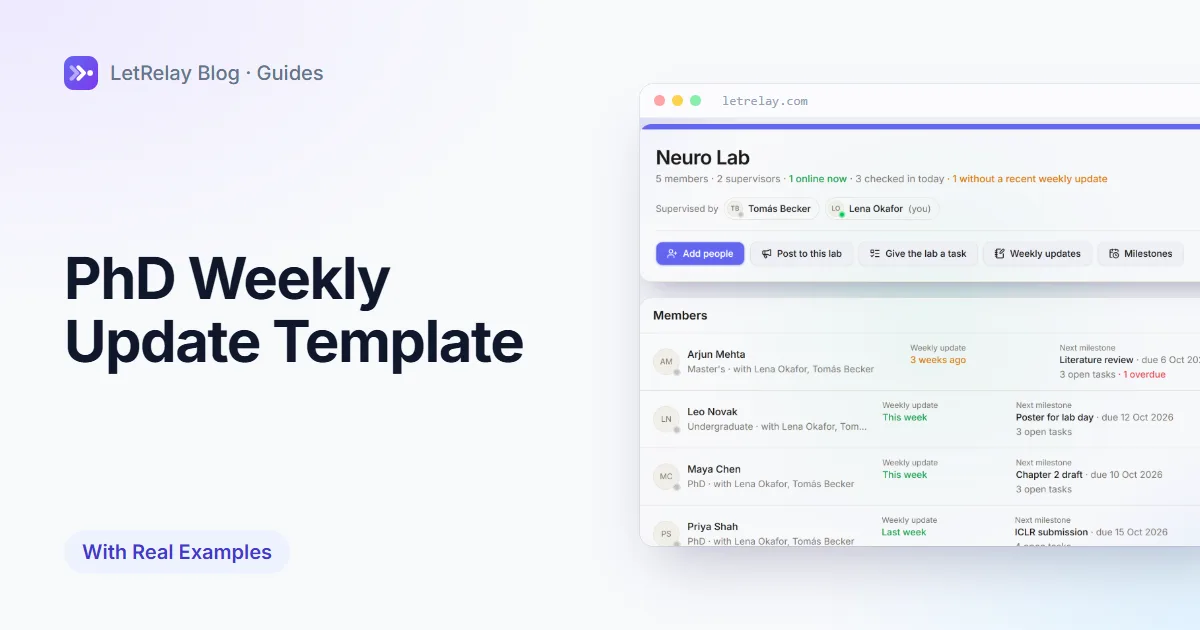
PhD Weekly Update Template (With Real Examples)
A weekly update a PhD student can write in three minutes and a supervisor can read in thirty seconds. The template, good and bad examples, versions for each stage of the degree, and how supervisors should answer.
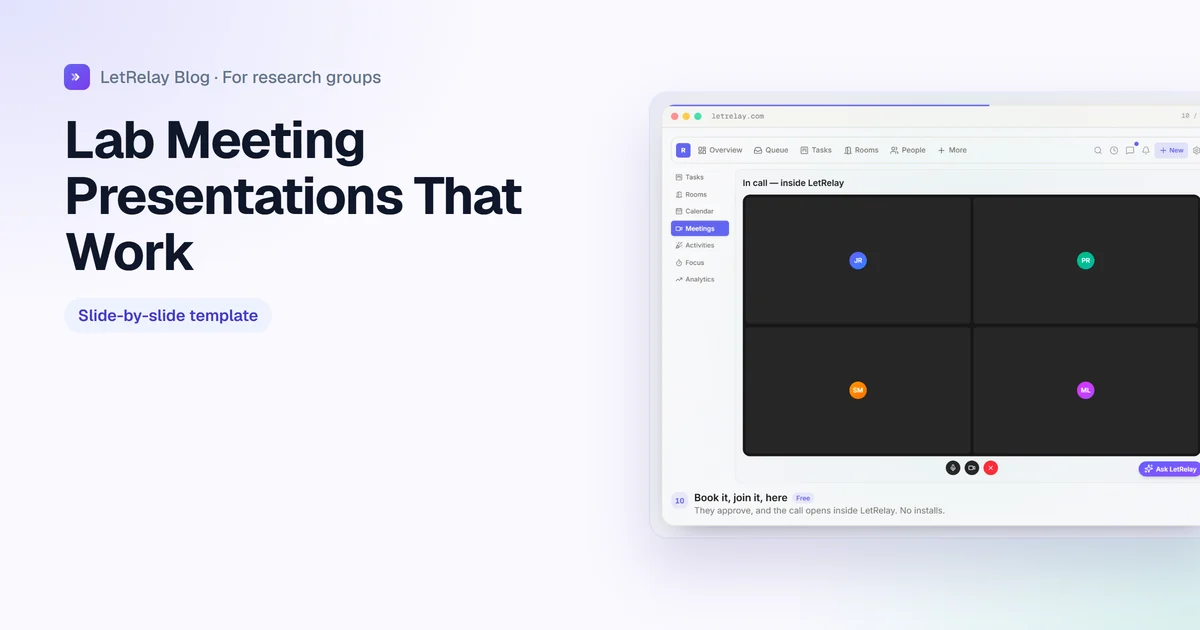
Lab Meeting Presentation: Template, Example and Tips
A slide-by-slide lab meeting presentation template, how to present when nothing worked, and how PIs can run lab meetings people actually learn from.