Journal Club Presentation: Template, Example and Tips
A slide-by-slide journal club presentation template, the critique questions that start a real discussion, a one-page handout, and how to run a journal club.
A journal club presentation has six parts: why the paper matters, what question it asks, how the authors answered it, what they found (walking through the key figures), what you think of it, and two or three questions for the room. For a 20-minute slot, that is about 10 to 14 slides and at least five minutes of discussion. The critique and the questions are what make it a journal club rather than a summary; spend the most preparation time on them.
This guide gives you a slide-by-slide template, the critique questions that actually start a conversation, a one-page handout, and a section for whoever runs the journal club: how to choose papers, keep a rota, and stop the session turning into the presenter reading the abstract aloud.
The template
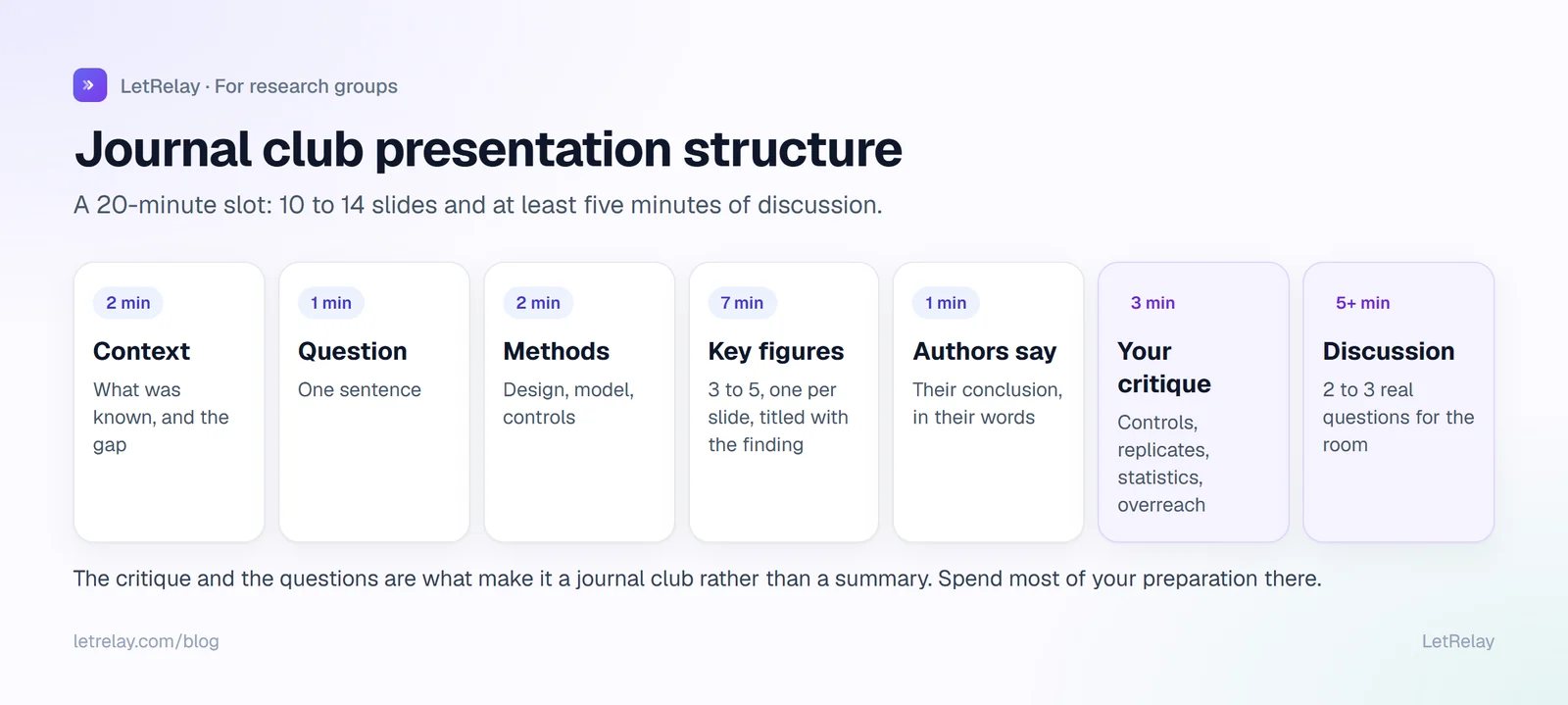
The University of Illinois physics department's journal club template, by Celia Elliott, frames the talk as six questions: what is new about the paper, where it fits in prior work, what methods were used, what the primary results were, what the authors think they mean, and what your assessment is. Turned into slides:
| Slide | Content | Time |
|---|---|---|
| 1 | Title, authors, journal, year, and one sentence on why you chose it | 0:30 |
| 2 | Background: what was known, and the gap. Only what the room needs. | 2 |
| 3 | The question or hypothesis, in one sentence | 1 |
| 4 | Design and methods: model, samples, key techniques, controls | 2 |
| 5 to 9 | Key figures, one per slide, each with a sentence title stating what it shows | 7 |
| 10 | The authors' conclusions, in their words | 1 |
| 11 | Your critique: strengths, weaknesses, alternative explanations | 3 |
| 12 | So what: what it changes for your field or your lab | 1 |
| 13 | Two or three discussion questions | discussion |
A few rules make this work:
- Do not present every figure. Choose the three to five that carry the argument. Put the rest in backup slides.
- Re-draw or crop, do not screenshot the whole figure. Show panel B large, with the axis readable, and say what the audience should look at. A paper on evidence-based medicine journal clubs by Schwartz and colleagues makes the same point: bring your listeners' eyes to a particular row of a table or a bar on a graph.
- Title each slide with the finding. "Loss of X abolishes the response in vivo", not "Figure 3".
- Skip the outline slide. Elliott's template calls outline slides "vastly overrated". If you use one, make every line carry content.
The critique: questions that start a discussion
The critique slide is where most presentations fall flat. "The sample size was small" is an observation, not a critique. A useful critique says what that could change about the conclusion.
For experimental and basic science papers:
- Do the controls actually rule out the obvious alternative explanation?
- How many independent replicates were there, and are they biological or technical?
- Is the key result shown in more than one way (a second method, a second model)?
- Do the statistics match the design? Watch for many comparisons without correction.
- Do the conclusions go further than the data? Look for "shows" where "suggests" belongs.
- What experiment would you have asked for as a reviewer?
For clinical and applied papers, use a structured appraisal checklist. The Critical Appraisal Skills Programme (CASP) publishes free checklists for randomised trials, cohort studies, case-control studies, systematic reviews, qualitative studies and diagnostic studies. Work through the one that matches the study design before you write your critique slide; it will find the questions you did not think of.
Then turn two or three of your critique points into questions for the room: "If the effect only appears in male mice, would you trust it for the clinical claim in the abstract?" A question with a real disagreement behind it gets a discussion. "Any thoughts?" gets silence.
A worked example (structure only)
Here is how the template fills in for an imagined paper on a new antibiotic target:
1  "A new target for Gram-negative antibiotics" (J. Example, 2026).
   Chosen because our lab screens the same enzyme family.
2  Background: few new antibiotic classes for Gram-negative bacteria in
   recent decades; the outer membrane blocks most compounds.
3  Question: does inhibiting enzyme Y kill E. coli without crossing
   the outer membrane?
4  Methods: CRISPRi knockdown, a compound screen, mouse thigh infection
   model. Controls: inactive analogue, efflux-deficient strain.
5  Fig 1B: knockdown of Y stops growth in 6 hours.
6  Fig 2A: the lead compound binds Y (crystal structure).
7  Fig 3C: resistance arises in 1 in 10^9 cells, via one mutation.
8  Fig 4D: bacterial load falls 100-fold in mice.
10 Authors: "Y is a viable target for a new antibiotic class."
11 Critique: mouse model used a high dose once; no toxicity data; the
   resistance mutation could be common in clinical isolates (not tested).
12 For us: our screen already includes Y's homologue. Worth testing.
13 Questions: Is 1 in 10^9 resistance low enough? Would you trust the
   mouse data without a dose-response?
The one-page handout
Schwartz and colleagues end their journal club advice with a one-page summary handout: it doubles as your speaking notes and gives the group a record. Keep it to the essentials:
Paper:       full citation + link
Presenter:   name, date
Question:    one sentence
Design:      model / population, sample size, key methods, controls
Main result: one to three sentences, with the numbers
Authors say: their conclusion
We think:    two or three critique points
Discuss:     two or three questions
Relevance:   what it means for our lab or practice
Before you present: a checklist
- Read the paper twice: once for the story, once with the supplementary material. The controls are often in the supplement.
- Read one earlier paper it builds on and one that disagrees with it, if there is one.
- Look up any method you could not explain to a first-year student.
- Check whether there are comments, corrections, or follow-up papers since publication.
- Rehearse the figure slides out loud. Explaining a figure takes longer than you think.
- Send the paper to the group at least a week ahead, so people can read it.
For whoever runs the journal club
A journal club lives or dies on three things: paper choice, a reliable rota, and discussion.
Paper choice. The editors of the Evidence-Based Medicine journal made a sharp point in the same issue as Schwartz's article: many journal clubs are boring because the chosen paper is quickly dismissed as poor research and nothing changes. Screen papers for basic quality before the session, or deliberately pick a flawed high-profile paper and make finding the flaws the exercise. Rotate between papers central to the lab's work, papers from neighbouring fields, and classics that every member should know.
A rota published for the term. Presenters prepare better with three weeks' notice. Name a backup for each session so illness never cancels it.
Discussion before verdict. Ask the most junior people for their view first. If the PI gives a verdict in the first minute, the discussion is over.
Keep it short. An hour is plenty. A journal club that reliably ends on time is one people come back to.
Record it. Keep a list of papers discussed, with the handout. After a year, it is a reading list for every new member.
Journal club is one format among several a lab can rotate through. For the others, including research updates and troubleshooting sessions, see our guide to lab meeting presentations.
How LetRelay does it
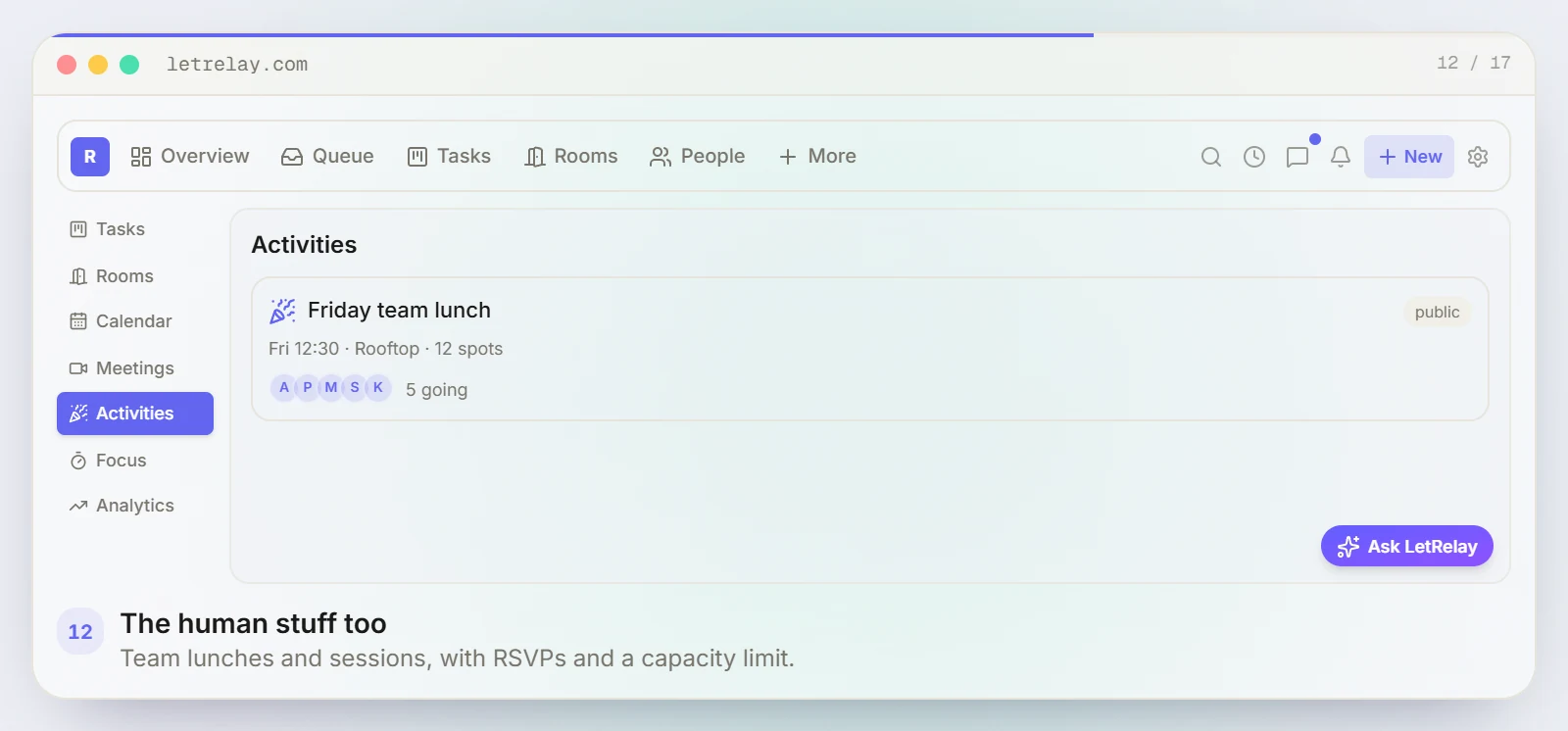
In LetRelay, a journal club session can be set up as an activity with RSVPs and a capacity limit, and it appears on the lab's shared calendar next to lab meetings and deadlines. The presenter rota can live on the lab's duty roster, where everyone sees who is up next. Handouts and the list of past papers can go in the lab's knowledge base, where new members will find them. (For what else a group workspace should do, see lab management software for research groups.) More on the LetRelay for research groups page.
FAQ
How long should a journal club presentation be?
Commonly 15 to 30 minutes of presenting, with at least a third of the session left for discussion. Clinical journal clubs are often shorter; Schwartz and colleagues' guide is built around presenting a paper in under ten minutes.
How many slides should a journal club presentation have?
About one slide per minute of talking: 10 to 14 slides for a 20-minute slot, with extra figures in backup slides.
How do you choose a paper for journal club?
Pick a recent paper relevant to the group's work, a paper from a neighbouring field the group should know about, or a deliberately flawed high-profile paper to practise critique. Screen it for basic quality first, and send it out at least a week ahead.
What should the critique in a journal club include?
Whether the controls rule out alternative explanations, the number and type of replicates, whether the statistics fit the design, whether the conclusions go beyond the data, and what additional experiment would settle the question. For clinical papers, use a CASP checklist for the study design.
How do you lead a journal club discussion?
Prepare two or three specific questions based on real weaknesses or disagreements, ask junior members first, and keep senior voices for the end. Close with what, if anything, the paper changes for the group.
Sources
- Elliott, C. M., University of Illinois Department of Physics: A template for journal club presentations (PDF)
- Schwartz, M. D., Dowell, D., Aperi, J. and Kalet, A. L. (2007). Improving journal club presentations, or, I can present that paper in under 10 minutes. Evidence-Based Medicine 12(3), 66-68 (PDF via Penn Medicine)
- Critical Appraisal Skills Programme (CASP): Critical appraisal checklists
Building LetRelay, the workspace for research groups and small teams: lab management, supervision tools, and an internal request desk with AI triage and SLA tracking.
Run your internal requests on LetRelay
AI triage, SLA-tracked queues, and bottleneck analytics — the help desk your team actually likes. Free to start.
Keep reading
Lab Meeting Presentation: Template, Example and Tips
A slide-by-slide lab meeting presentation template, how to present when nothing worked, and how PIs can run lab meetings people actually learn from.
PhD Timeline Template: Year-by-Year Plan and Gantt Chart
Year-by-year PhD timelines for US and UK-style programs, a Gantt chart you can build in Excel or Sheets in ten minutes, and how supervisors keep it on track.
How to Write a Recommendation Letter for a Graduate Student
A paragraph-by-paragraph structure, an example letter, the phrases that quietly weaken a letter, and a workflow for PIs writing dozens each season.