PhD Timeline Template: Year-by-Year Plan and Gantt Chart
Year-by-year PhD timelines for US and UK-style programs, a Gantt chart you can build in Excel or Sheets in ten minutes, and how supervisors keep it on track.
A useful PhD timeline starts from the date your funding ends and works backwards. It lists your program's fixed milestones (coursework, qualifying exam or confirmation review, thesis proposal, annual reviews, submission and defense), the papers you plan to write, and a writing-up period, with a buffer before every hard deadline. Keep it to one page, put it in a Gantt chart so overlaps are visible, and review it with your supervisor every term, not only at the annual review.
How long you have depends on where you are. In the United States, the median time from starting a doctoral program to finishing was 5.7 years for 2023 graduates across all fields, according to the National Science Foundation's Survey of Earned Doctorates. In the UK, UKRI says funding for full-time studentships usually lasts between three and four years. Your timeline has to fit the money, not the other way round.
How long a PhD takes, by field
Median years from starting a doctoral program to receiving the degree, US doctorates awarded in 2023 (NCSES, Survey of Earned Doctorates, Table 1-12):
| Field | Median years |
|---|---|
| All fields | 5.7 |
| Science and engineering overall | 5.6 |
| Biological and biomedical sciences | 5.7 |
| Computer and information sciences | 5.6 |
| Engineering | 5.3 |
| Agricultural sciences and natural resources | 5.0 |
Two practical consequences. First, a US five-year plan with no buffer is already tighter than the median. Second, in systems with three to four years of funding, the writing-up period is the part that gets squeezed; plan it from the start.
Year-by-year template: US-style program (5 years)
Milestone names and timing vary by program; replace them with your handbook's.
| Year | Main work | Milestones |
|---|---|---|
| 1 | Coursework, rotations (in many biomedical programs), reading, first experiments | Choose advisor; form committee |
| 2 | Finish coursework, first real project, first conference abstract | Qualifying or comprehensive exam |
| 3 | Main project, first first-author paper submitted | Thesis proposal and advancement to candidacy; annual committee meeting |
| 4 | Second project or paper, teaching done, start planning the thesis | Annual committee meeting; decide on the thesis structure |
| 5 | Final experiments by mid-year, writing up, job search | Committee approval to write; thesis submission; defense |
Year-by-year template: UK and European-style program (3.5 to 4 years)
| Period | Main work | Milestones |
|---|---|---|
| Months 1 to 12 | Literature review, methods training, first study | First-year review or confirmation of registration (timing set by your university) |
| Months 13 to 24 | Main studies, first paper | Annual progress review |
| Months 25 to 36 | Final studies, second paper, thesis outline agreed | Annual progress review; decision on submission date |
| Months 37 to 42 (or 48) | Writing up, final analyses only | Thesis submission; viva; corrections |
In three-to-four-year programs, the last six months should be writing only. New experiments in the final half-year are the most common reason students run past their funding.
Build the Gantt chart in ten minutes
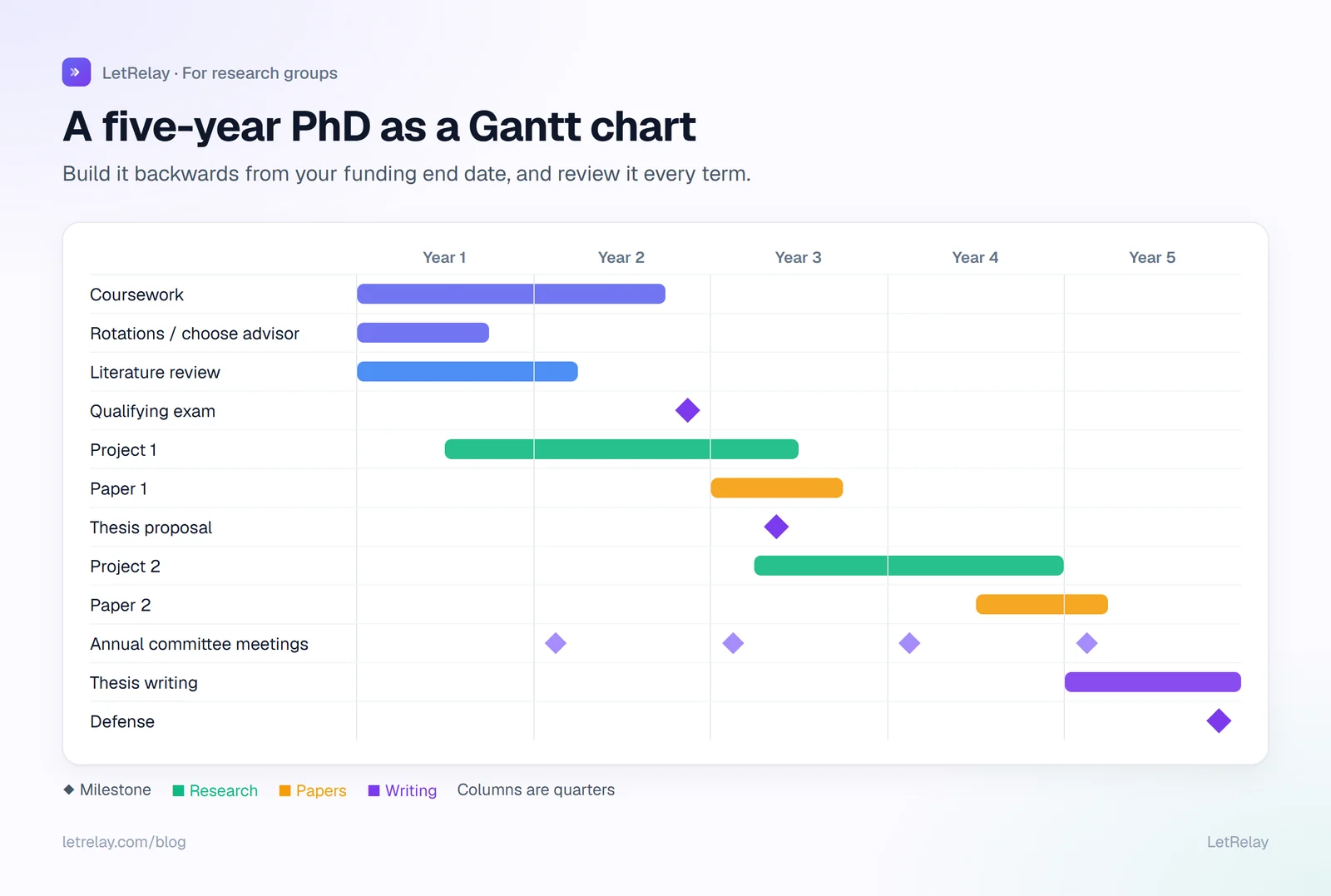
You do not need special software. In Excel or Google Sheets:
- Put one task per row: task name, start month, end month.
- Put the months of your PhD across the top, one column each (for a five-year PhD, 60 columns).
- Fill a cell when the month falls between the task's start and end. In Sheets, use conditional formatting with a custom formula such as
=AND(E$1>=$B2, E$1<=$C2), where row 1 holds each column's month and B and C hold the start and end. Write every month the same way, for example 2026-09, so the comparison works. - Add milestone rows with the same start and end month and a different colour.
- Freeze the task column so it stays visible when you scroll.
As a starting list, copy this into the first three columns:
Task,Start,End
Coursework,2026-09,2027-12
Rotations / choose advisor,2026-09,2027-03
Literature review,2026-10,2027-06
Qualifying exam (milestone),2028-05,2028-05
Project 1: experiments,2027-03,2028-12
Paper 1: writing and submission,2028-09,2029-03
Thesis proposal (milestone),2029-01,2029-01
Project 2: experiments,2029-01,2030-06
Paper 2: writing and submission,2030-03,2030-09
Annual committee meetings (milestones),2027-10,2030-10
Thesis writing,2030-09,2031-05
Defense (milestone),2031-06,2031-06
Rules that keep a timeline honest
Work backwards from the hard dates. Funding end, visa or permit expiry, and any program time limit are fixed. Put them in first; everything else fits around them.
Add a buffer before each hard deadline. Experiments fail, reviewers ask for more, co-authors are slow. A few weeks before each milestone and a few months before submission is not pessimism; the national median shows how often plans run long.
Separate hard and soft milestones. Hard: set by the program or funder, with consequences if missed. Soft: your own targets, such as "paper 1 submitted". Mark them differently in the chart. Committee meetings are the best-known hard milestone; see how to prepare for a committee meeting.
Plan papers around real deadlines. If your field publishes through conferences, add the deadlines you are aiming for, and remember many are set in Anywhere on Earth time. Our guide on AoE deadlines explains how to read them.
Keep it to one page. A timeline that needs scrolling will not be updated. Detail belongs in your weekly plans.
Review it every term. Put a date in your calendar. Bring it to your 1:1 and ask what has changed.
Updating the timeline without panicking
Every PhD timeline changes. The point is to notice early. Each term, ask three questions: which milestone is now at risk, what would have to be true to still meet it, and what can be dropped if not. Bring the answers to your supervisor as a proposal, not a confession: "Project 2 is three months behind. If I narrow it to the two conditions that matter for the thesis, I still submit in May. If not, I need until September, and my funding ends in June." That is a conversation a supervisor can act on.
A written weekly update makes this much easier, because the slip shows up in weeks, not at the annual review. See our PhD weekly update template.
For supervisors: keeping a lab's timelines on track
A PI with eight students is tracking eight timelines, each with its own milestones, funding end and, for international students, visa dates. A few habits help:
- Ask every student for a one-page timeline in their first term, and review it at each annual review.
- Keep the hard dates in one place for the whole lab: milestones, funding ends, visa expiry.
- Sign off each milestone explicitly (plan agreed, exam passed), so nobody discovers in year four that a step was never recorded.
- Watch for the same "next step" repeating in weekly updates for several weeks. It is the earliest sign a timeline is slipping.
For graduate program administrators, the same list, across all students, is what makes annual reporting and funding decisions straightforward.
How LetRelay does it
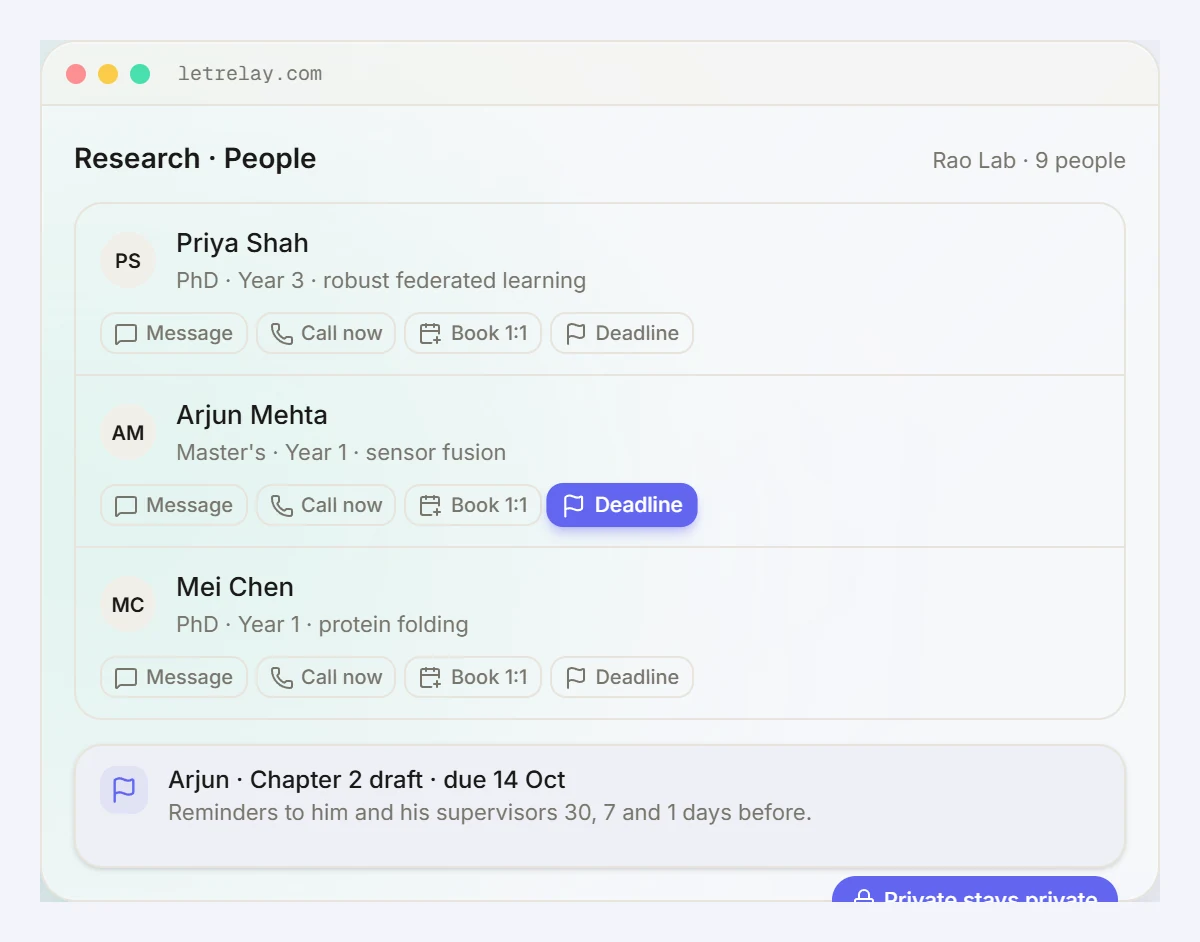
In a LetRelay research group, degree milestones (qualifying exam, proposal, annual review, thesis, defense) carry a due date and a supervisor sign-off, and send reminders 30, 7 and 1 days before, to the student and to the supervisor. A PI can set any student a deadline, such as a chapter draft, from the People view, and papers move through a pipeline from idea to camera-ready with conference deadlines counted down in AoE. Funding end dates and visa or permit expiry show up well before they bite. More on the LetRelay for research groups page.
FAQ
How long does a PhD take?
In the US, the median time from starting a doctoral program to finishing was 5.7 years for 2023 graduates, ranging from about 5.0 to 5.7 years across the main science and engineering fields. In the UK, full-time UKRI studentships usually fund three to four years.
What should a PhD timeline include?
Your program's required milestones, your planned studies and papers, conference or submission deadlines, a writing-up period, buffers before each hard deadline, and fixed dates such as funding end and visa expiry.
How do I make a PhD Gantt chart in Excel?
List tasks with start and end months in the first columns, put months across the top, and use conditional formatting to fill each cell where the month falls between the start and end. Add milestones as one-month rows in a different colour.
How often should I update my PhD timeline?
At least once a term, and bring it to a supervision meeting each time. Update it immediately when a hard date changes, such as funding or an exam date.
What if my PhD timeline slips?
Work out which milestone is at risk and what could be narrowed or dropped, then bring your supervisor a proposal with options and dates. Slips caught early are usually manageable; slips discovered at the annual review are not.
Sources
Building LetRelay, the workspace for research groups and small teams: lab management, supervision tools, and an internal request desk with AI triage and SLA tracking.
Run your internal requests on LetRelay
AI triage, SLA-tracked queues, and bottleneck analytics — the help desk your team actually likes. Free to start.
Keep reading
How to Ask a Professor for a Recommendation Letter
When to ask, what to send, and the exact emails to use, plus how professors can handle a stack of letter requests without missing a deadline.
Journal Club Presentation: Template, Example and Tips
A slide-by-slide journal club presentation template, the critique questions that start a real discussion, a one-page handout, and how to run a journal club.
How to Write a Recommendation Letter for a Graduate Student
A paragraph-by-paragraph structure, an example letter, the phrases that quietly weaken a letter, and a workflow for PIs writing dozens each season.