NIH Data Management and Sharing Plan: 2026 Format Guide
The seven elements of NIH's 2026 DMS Plan format, how to answer each one, the 300 and 100 word limits, budgeting, and what the lab has to do after the award.
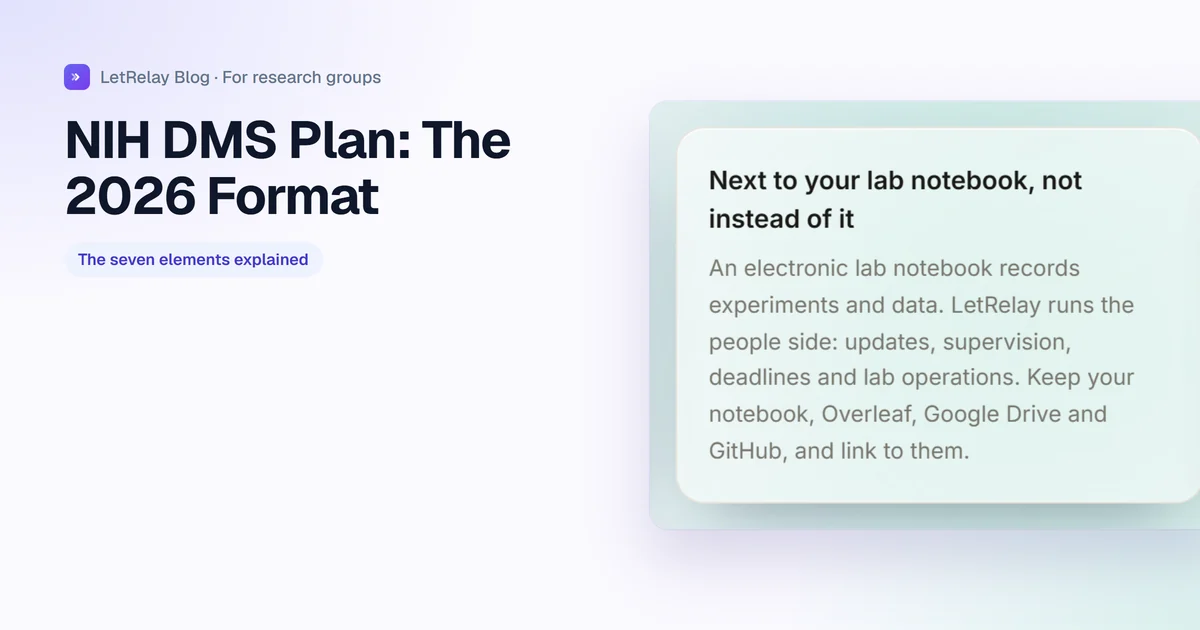
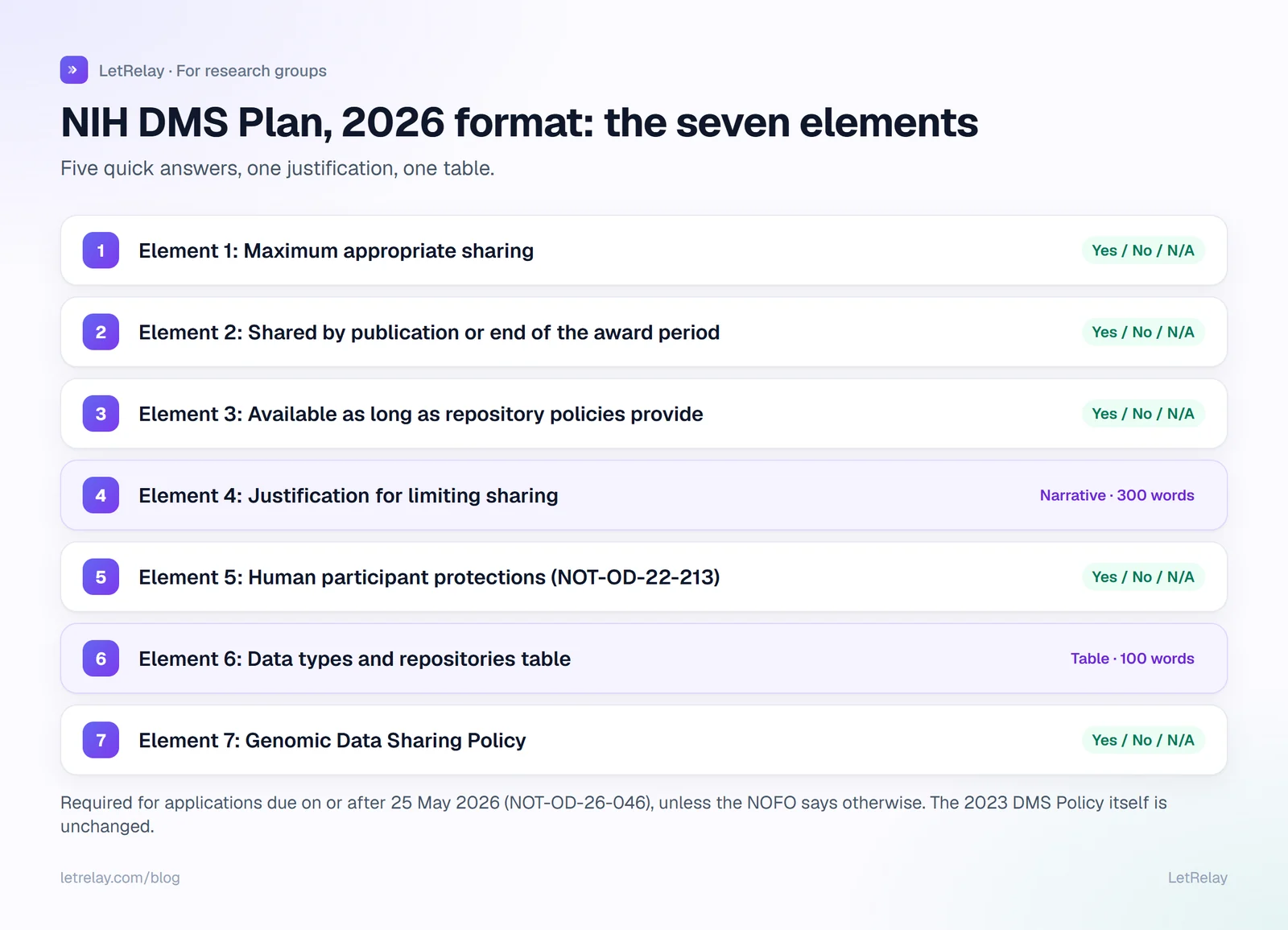
Since 25 May 2026, NIH Data Management and Sharing (DMS) Plans use a new structured format (notice NOT-OD-26-046): seven elements instead of six narrative sections. Five are answered Yes, No or Not Applicable, one is a justification for limiting sharing (up to 300 words), and one is a table of data types and repositories (up to 100 words). NIH calls it a pilot but expects it for all applications due on or after 25 May 2026; the 2023 DMS Policy itself has not changed.
This guide walks through each element, the answers that are usually right, the parts that still take real thinking, how to budget for data sharing, and what the lab actually has to do once the grant is funded. A note on sources: NIH's own grants pages sit behind bot protection that blocked our automated check, so the details below come from university research data offices that have published the format and NIH's clarifications. Always download the current template from NIH before you write.
What changed, in one table
| 2023 format | 2026 format | |
|---|---|---|
| Structure | Six narrative elements | Seven elements, mostly Yes / No / Not Applicable |
| Other templates | Allowed, if all elements were covered | NIH template expected (unless the NOFO says otherwise) |
| Word limits | Two-page recommendation | 300 words for Element 4, 100 words for Element 6 |
| Data and repositories | Described in prose | Listed in a data type and repository table |
| Applies to | Applications from 25 January 2023 | Applications due on or after 25 May 2026 |
Washington University's Becker Medical Library, which has been corresponding with NIH's Office of Policy for Extramural Research Administration (OPERA), summarises the key clarifications: the format is required across all NIH Institutes and Centers unless a NOFO specifies otherwise; NIH does not plan to publish sample plans in the new format; eRA does not currently validate the word counts, but NIH expects applicants to keep to them; and DMS questions now go to GrantsCompliance@od.nih.gov.
The seven elements, and how to answer each
Element 1: Maximum appropriate sharing (Yes / No / Not Applicable). Will scientific data be shared as openly as possible and as restricted as necessary? Usually Yes. If some data can only be shared under controlled access, you can still answer Yes to maximum appropriate sharing, and explain the restriction in Element 4.
Element 2: Timing (Yes / No / Not Applicable). Will data be shared no later than publication or the end of the performance period, whichever comes first? Usually Yes. Exceptions exist, for example around SBIR and STTR projects or patent applications; check NIH's DMS FAQs if either applies.
Element 3: Duration (Yes / No / Not Applicable). Will the data stay available as long as the repository's policies provide? If you choose an established repository, the answer is usually Yes. Check your institution's own retention rules as well.
Element 4: Justification for limiting sharing (up to 300 words). This is where the real thinking goes. Explain any restriction and why it is necessary: participant privacy and re-identification risk, limits in informed consent, legal or regulatory constraints, or technical limits that cannot reasonably be solved. Becker's guidance, based on NIH's FAQs, lists reasons NIH does not accept: the dataset is small, the data are not expected to be widely used, or a suitable repository has not been found. If you are sharing everything openly, this element can be very short.
Element 5: Human participant protections (Yes / No / Not Applicable). Confirms you will follow NIH's expectations for protecting participants' privacy when sharing data (NOT-OD-22-213). For human-participant research, a No signals non-compliance, so read the notice and plan consent and de-identification accordingly. For research without human participants, the answer is Not Applicable.
Element 6: Data types and repositories (up to 100 words). A table: each type of scientific data your project will generate, described by species and modality ("human single-cell RNA-seq", "mouse flow cytometry"), and the repository where it will go. Becker's advice is worth following: organise the table by shareable dataset rather than by aim, grouping data that will be deposited together under one repository and one persistent identifier. It makes the annual progress report much easier later.
Element 7: Genomic Data Sharing Policy (Yes / No / Not Applicable). For studies covered by NIH's Genomic Data Sharing (GDS) Policy, will large-scale human genomic data go to an NIH-designated repository on the GDS timelines? If your study is not covered, it is Not Applicable. A No needs justification in Element 4.
A worked example of Element 6
For an imagined project on immune cells in mouse models of lung infection:
Data type (species, modality)             Repository
Mouse single-cell RNA-seq                 GEO
Mouse flow cytometry (FCS files)          FlowRepository
Mouse lung histology images               BioImage Archive
Analysis code and processed tables        Zenodo (via GitHub release)
That is under 100 words, specific enough to check, and maps each dataset to one place and one future identifier. Confirm each repository still accepts your data type before you submit; your library's data services team can help.
Budgeting for data management and sharing
The new format does not change how you budget. NIH allows reasonable costs for data management and sharing in the grant budget, justified by the plan. Becker lists the common categories:
- data curation and preparation,
- documentation such as README files and data dictionaries,
- repository deposit fees,
- storage and platform costs,
- personnel effort for data management and sharing.
Becker also notes that the DMS budget is reviewed before applicants are selected for Just-in-Time submission, while the plan itself is reviewed at the Just-in-Time stage. Write the plan when you write the budget, even though it is reviewed later. Once the grant is funded, tracking a grant's burn rate shows whether the data costs you budgeted are being spent as planned.
After the award: what the lab has to do
A DMS Plan is a commitment, and NIH checks it. Since 1 October 2024, annual progress reports (RPPRs) ask whether scientific data have been generated, whether they have been shared, where, and under which persistent identifier such as a DOI or accession number. If the plan changes significantly, an updated plan needs NIH approval (NOT-OD-24-176).
In practice, that turns into lab routines:
- Name an owner per dataset in the Element 6 table. Usually the student or postdoc who generates it, with the PI accountable.
- Write the README as you go, not the week of the deposit.
- Tie deposits to papers. When a manuscript is submitted, the deposit for its data is due. Put it on the same checklist.
- Record identifiers (DOIs, accession numbers) in one place the PI can copy into the RPPR.
- Keep a lab data SOP: where raw data live, naming conventions, backups, and who can access what. It belongs in the same place as the rest of your lab expectations.
For students and postdocs
You will do most of the actual data sharing. Ask your PI which datasets from the plan are yours, use the lab's naming and folder conventions from day one, and deposit data when the paper is submitted, not after it is published and you have moved on. A dataset with a DOI and a clear README is also a citable output for your CV.
For NSF applicants
NSF is changing how plans are submitted, not what they contain. According to Johns Hopkins University's Data Services, since 27 April 2026 NSF requires the Data Management and Sharing Plan to be completed as a form in Research.gov rather than uploaded as a document, and the elements of the plan are not changing.
How LetRelay does it
LetRelay does not store research data; your notebook, repositories, Drive and GitHub do, and LetRelay links to them. What it handles is the part of a DMS Plan that depends on people remembering: the lab's data SOP lives in the knowledge base, each deposit can be a task with an owner and a due date tied to the paper, papers move through a pipeline from idea to camera-ready, and each grant's end date shows up well before it arrives. For a wider look at tools, see lab management software for research groups. More on the LetRelay for research groups page.
FAQ
What is the new NIH DMS Plan format for 2026?
A structured format with seven elements, effective for applications due on or after 25 May 2026 (NOT-OD-26-046). Elements 1 to 3, 5 and 7 are answered Yes, No or Not Applicable; Element 4 is a justification for limiting sharing of up to 300 words; and Element 6 is a table of data types and repositories of up to 100 words.
Is the 2026 NIH DMS Plan format optional?
No. Although NIH calls it a pilot, NIH expects applicants to use its template for applications due on or after 25 May 2026, unless the funding opportunity specifies otherwise.
What are the word limits for the NIH DMS Plan?
300 words for Element 4 (justification for limiting sharing) and 100 words for Element 6 (data types and repositories). eRA does not currently validate the counts, but NIH expects applicants to keep to them.
Can I budget for data management and sharing in an NIH grant?
Yes. Reasonable costs such as data curation, documentation, repository fees, storage and personnel effort can be requested, justified by the plan.
Does the 2026 format change the NIH Data Management and Sharing Policy?
No. The 2023 DMS Policy still applies; only the format of the plan has changed.
Who reviews the NIH DMS Plan?
NIH staff review the plan at the Just-in-Time stage. The data management and sharing budget is looked at earlier, before applicants are selected for Just-in-Time, which is why the plan should be written when the budget is prepared.
Sources
- Becker Medical Library, Washington University: Updated resources for 2026 NIH Data Management and Sharing Plan format (July 2026)
- Becker Medical Library, Washington University: NIH DMS Plan format updates, 2026 edition (March 2026)
- NIH Extramural Nexus: 2026 pilot Data Management and Sharing Plan format available
- NIH Grants and Funding: Writing a Data Management and Sharing Plan
- Johns Hopkins University Data Services: NIH/NSF Data Management and Sharing Plan update and support
Building LetRelay, the workspace for research groups and small teams: lab management, supervision tools, and an internal request desk with AI triage and SLA tracking.
Run your internal requests on LetRelay
AI triage, SLA-tracked queues, and bottleneck analytics — the help desk your team actually likes. Free to start.
Keep reading
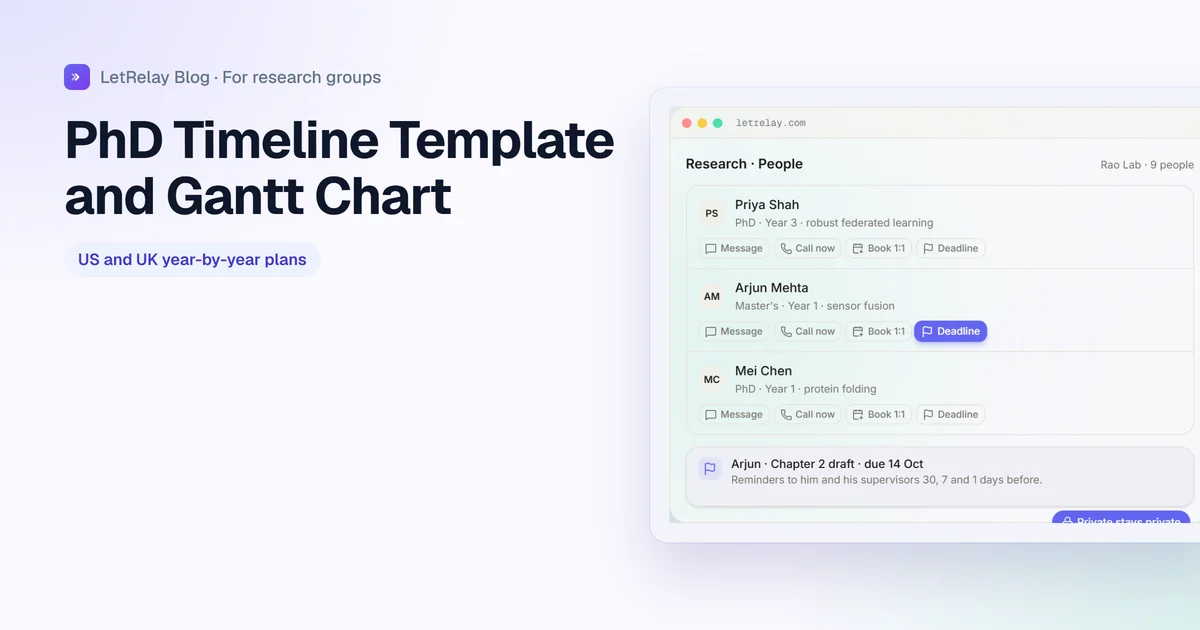
PhD Timeline Template: Year-by-Year Plan and Gantt Chart
Year-by-year PhD timelines for US and UK-style programs, a Gantt chart you can build in Excel or Sheets in ten minutes, and how supervisors keep it on track.
Lab Inventory Management: Spreadsheet Template and Tools
The columns a lab inventory spreadsheet needs, how to set reorder levels, a simple ordering workflow, and when to move to free or paid inventory software.
Lab Equipment Booking System: Fair Rules and Free Options
Booking rules that keep shared microscopes, instruments and GPU nodes fair, a copyable policy, and an honest comparison of free and paid lab booking systems.