PhD Supervision Meeting Agenda: 1:1 Template and Questions
A 1:1 agenda for PhD supervision meetings, questions for your first meeting with a supervisor, a notes template, and how supervisors make meetings count.
A good PhD supervision meeting has a short written agenda sent a day ahead, and follows the same order every time: what you achieved since last time, feedback in both directions, the questions and decisions you need help with, the plan for the next few weeks, the single most important next step, and the date of the next meeting. The student takes notes and sends them afterwards with agreed actions. Most of the time goes to the questions and decisions.
That is close to the structure Imperial College London recommends to its supervisors. The rest of this guide gives you the template, the questions to ask in your first meeting with a new supervisor, a notes format that makes the next meeting easier, and advice for supervisors on making these meetings the most useful hour of a student's week.
Why the 1:1 matters so much
Supervision is the single strongest thing a lab can offer a PhD student. In Nature's 2025 survey of more than 3,700 doctoral students, about half said their supervisor spent less than an hour a week with them. Some 69% of that group were at least moderately satisfied with their PhD, compared with around 82% of students who met their supervisor more often. A regular, prepared 1:1 is the cheapest improvement most labs can make.
The agenda template
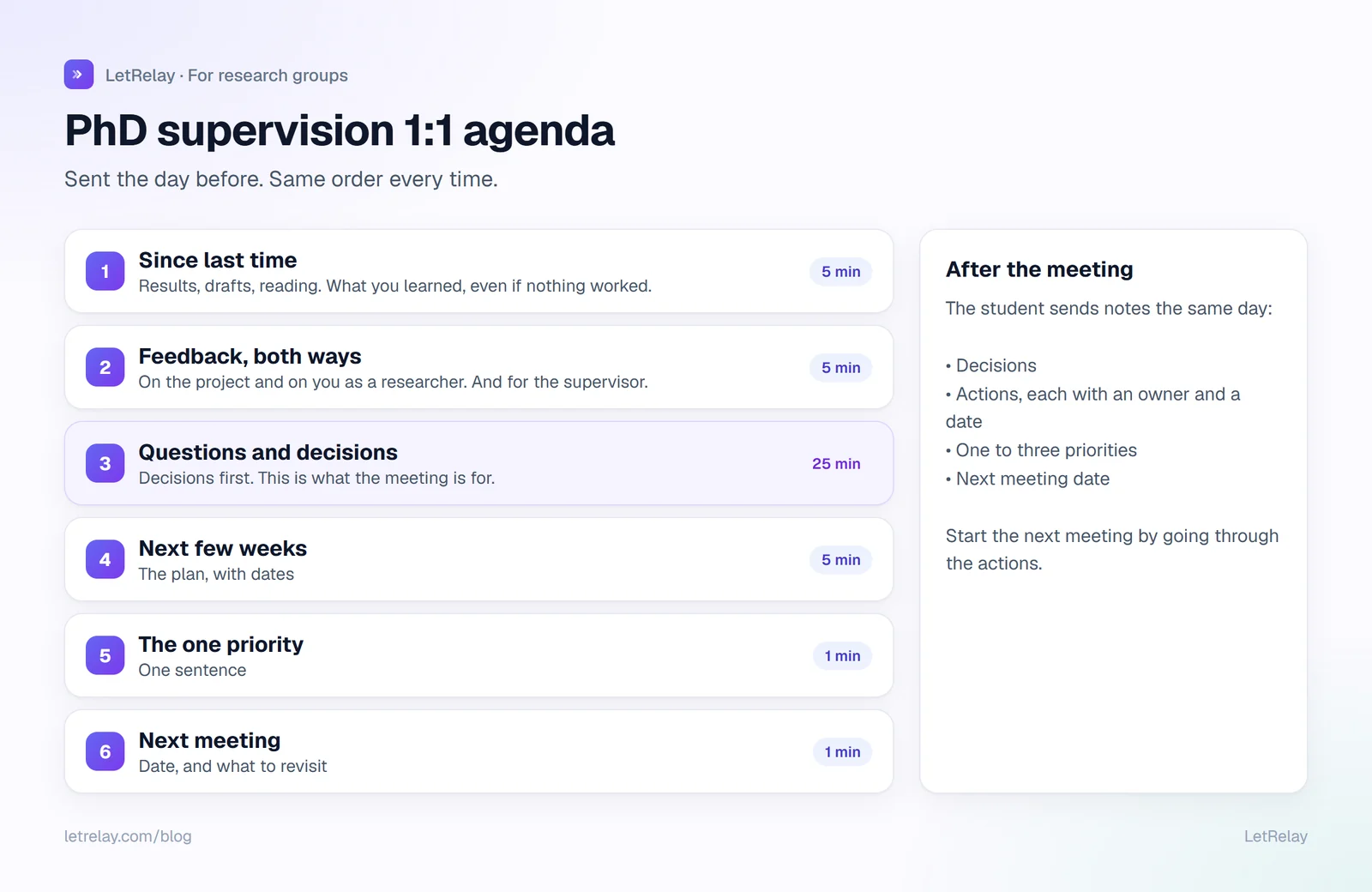
Imperial College London's advice sheet on effective PhD supervision meeting agendas lists seven items: achievements since last time; feedback to the student; feedback to the supervisor; current questions, issues and decisions; what the student will do in the next few weeks or months; the immediate priority; and the date and content of the next meeting. As a copyable version:
Supervision meeting, [date]                     Student: [name]

1. Since last time (5 min)
   - Results, drafts, reading. Link the notebook or document.
   - What I learned, even if nothing worked.

2. Feedback (5 min)
   - For me: how is the project going, and how am I developing?
   - For you: anything I need more or less of from you?

3. Questions and decisions (25 min)
   - [Decision 1: e.g. drop condition C or add three weeks?]
   - [Question 2: interpretation of figure 2]
   - [Blocker: waiting on cluster access since Tuesday]

4. Next few weeks (5 min)
   - [Plan, with dates]

5. The one priority before next time
   - [One sentence]

6. Next meeting
   - [Date, and anything to revisit]
Send it the day before. Put the decisions first under item 3 if time is short; they are what the meeting is for.
Why feedback belongs near the top
Imperial's advice makes a point many supervisors miss: feedback is often left to the end of the meeting or dropped entirely, but it should appear near the top, and it should cover two separate things, the progress of the project and the student's development as a researcher. A student can be doing well on one and stalling on the other.
Feedback should also go the other way. The same advice sheet suggests the supervisor simply ask whether there is anything the student would like them to do differently, start or stop, to help them make progress. Asked every time, it stops being awkward.
When there is "nothing to report"
Students often try to cancel a meeting when an experiment failed or a chapter went backwards. Imperial's sheet says this is exactly when they need their supervisor: to see what they learned, what is normal at this stage of a PhD, and where the project stands in the bigger picture. Keep the meeting. Shorten it if you like, but keep it.
Your first meeting with a new supervisor
The first 1:1 sets expectations for the next four years. Bring these questions, and write the answers down:
- How often will we meet one-to-one, and who schedules it?
- How would you like updates between meetings? A short weekly written update, a message, or only at meetings?
- How quickly can I expect comments on a draft, and how much notice do you need before a deadline?
- What should I aim to have done in the first three months? What does a good first year look like?
- How are decisions about authorship made in the lab?
- What are the program's milestones and dates I should put in my timeline now?
- How do you prefer to be contacted for something urgent?
- Who else should I learn from: postdocs, staff scientists, other students?
If the lab has an expectations document, read it before the meeting and ask about anything unclear. Our guide to the lab expectations document shows what a good one covers, and choosing a PhD advisor covers the questions to ask before you join.
The notes template
The student takes notes and sends them the same day. It takes ten minutes and saves arguments later. The Wallace lab at the University of Edinburgh asks lab members to email a summary after each fortnightly 1:1 that includes one to three priorities for the next two weeks. A simple format:
Notes, supervision meeting [date]

Decisions
- Drop condition C; focus on A and B for the paper.

Actions
- [Student] Re-run the ablation with fixed seeds, by 14 Nov.
- [Supervisor] Ask facility manager about cluster priority, by 7 Nov.
- [Student] Send chapter 2 draft, by 28 Nov.

Priorities until next meeting (1 to 3)
1. Ablation results
2. Chapter 2 draft

Next meeting: [date]. Revisit: figure 2 interpretation.
Actions with an owner and a date are the part that matters. Start the next meeting by going through them.
How often to meet
There is no single right answer, but there is a wrong one: "whenever you need me", because students rarely ask. Common rhythms are weekly for first-year students and anyone near a deadline, and every two weeks for established students; the Edinburgh lab above uses fortnightly 1:1s of about an hour. Whatever the rhythm, put it in the calendar as a recurring meeting and move it rather than cancel it.
Between meetings, a short written weekly update carries the routine information, so the 1:1 can be spent on decisions. See our PhD weekly update template.
For supervisors: making 1:1s count
- Protect the slot. A recurring meeting that you rarely cancel is the clearest signal of commitment a student gets.
- Read the agenda and last week's update first. Five minutes before the meeting saves fifteen in it.
- Let the student run the meeting. It is their project; you are there to help them decide.
- Give feedback on the researcher, not only the project. Writing, independence, how they handle setbacks.
- Close with one priority. A student who leaves with ten things to do does none of them well.
- Watch the pattern across meetings. The same blocker three times, or a student who keeps postponing, needs a different conversation. Our guide on how to manage PhD students without chasing them covers the whole weekly loop.
- Keep the milestones in view. Bring the student's PhD timeline to at least one meeting a term.
Co-supervisors and committees
With two supervisors, agree who the student meets and how often, and copy the notes to both. Disagreements between supervisors should be resolved between them, not through the student. For committee members who are not in regular 1:1s, the notes from supervision meetings are the best preparation for committee meetings.
How LetRelay does it
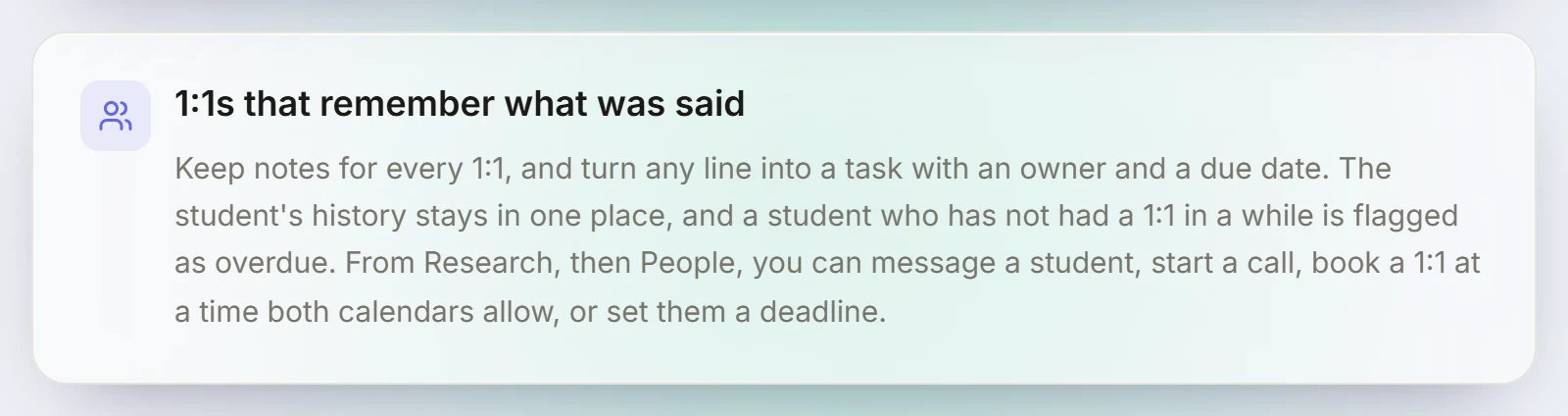
In a LetRelay research group, notes are kept for every 1:1, and any line can be turned into a task with an owner and a due date, so the actions list writes itself. Each student's history stays in one place, and a student who has not had a 1:1 in a while is flagged as overdue. From Research, then People, a supervisor can message a student, start a call, book a 1:1 at a time both calendars allow, or set a deadline. Friday updates and the Monday digest carry the routine news between meetings. More on the LetRelay for research groups page.
FAQ
What should be on a PhD supervision meeting agenda?
Achievements since the last meeting, feedback to the student and to the supervisor, questions and decisions, the plan for the next few weeks, the one immediate priority, and the date of the next meeting. Send it the day before.
What questions should I ask my PhD supervisor in the first meeting?
How often you will meet and who schedules it, how to send updates, how quickly drafts are returned, what a good first year looks like, how authorship is decided, which program milestones to plan for, and how to reach them urgently.
How often should a PhD student meet their supervisor?
A regular rhythm matters more than the exact number: weekly for new students and anyone near a deadline, every two weeks for established students is common. Nature's 2025 survey found students who met their supervisors for an hour a week or more were more satisfied.
Who should take notes in a PhD supervision meeting?
The student. Send the notes the same day with decisions, actions with owners and dates, and one to three priorities until the next meeting.
What if my supervisor keeps cancelling meetings?
Propose a fixed recurring slot, keep your agenda short and decision-focused, and send a written update weekly so progress continues. If meetings still do not happen, raise it with your co-supervisor, committee or graduate program director.
Sources
Building LetRelay, the workspace for research groups and small teams: lab management, supervision tools, and an internal request desk with AI triage and SLA tracking.
Run your internal requests on LetRelay
AI triage, SLA-tracked queues, and bottleneck analytics — the help desk your team actually likes. Free to start.
Keep reading
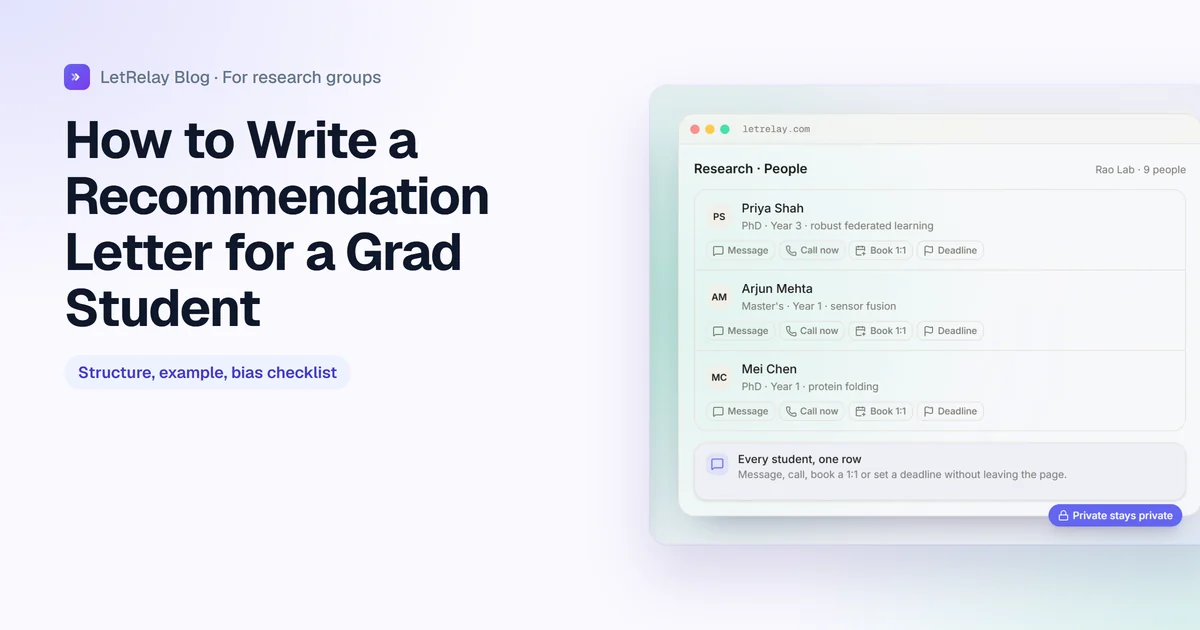
How to Write a Recommendation Letter for a Graduate Student
A paragraph-by-paragraph structure, an example letter, the phrases that quietly weaken a letter, and a workflow for PIs writing dozens each season.
How to Email a Potential PhD Supervisor (With Examples)
When emailing a professor helps your PhD application and when it does not, what to write, two example emails, and how PIs can handle inquiries fairly.
PhD Weekly Update Template (With Real Examples)
A weekly update a PhD student can write in three minutes and a supervisor can read in thirty seconds. The template, good and bad examples, versions for each stage of the degree, and how supervisors should answer.