PhD Committee Meeting: How to Prepare, Agenda and Slides
A six-week preparation plan for PhD committee meetings, the written report, a slide outline and agenda, what to do afterwards, and how supervisors should help.

Prepare for a PhD committee meeting in three pieces. Send a short written report and your program's form about ten days ahead. Give a presentation of around 20 minutes on progress against the plan the committee last agreed. And end the meeting with explicit decisions: what is approved, what needs to change, and when you meet next. Before the meeting, agree with your supervisor on the two or three questions you most need the committee to answer; afterwards, send a written summary within a few days.
Committee meetings are one of the few times several experienced researchers focus on your project at once. Students often treat them as an exam to survive. They work better as a meeting you run to get decisions and advice. This guide gives a preparation timeline, the report, a slide outline, a meeting agenda, what to do afterwards, and notes for supervisors and committee members.
What your program actually requires
Rules differ, so start with your handbook. Two real examples show the typical shape:
- University of Wisconsin–Madison, Cancer Biology PhD (years 3 and later): an annual committee meeting held by 31 August; the written report, the program's committee meeting form and the meeting details sent to all members at least 10 days before; a 20-minute presentation on research progress; and at least three committee members present, including the mentor.
- University of Saskatchewan, Pharmacy and Nutrition graduate programs: the thesis proposal sent to the advisory committee at least one week before the proposal meeting, a presentation of 15 to 20 minutes, and the committee chair records minutes and files the report afterwards; if a year passes without a meeting, the student should update the committee.
Write your program's deadlines, forms and minimum attendance into your PhD timeline as soon as you know them.
A six-week preparation plan
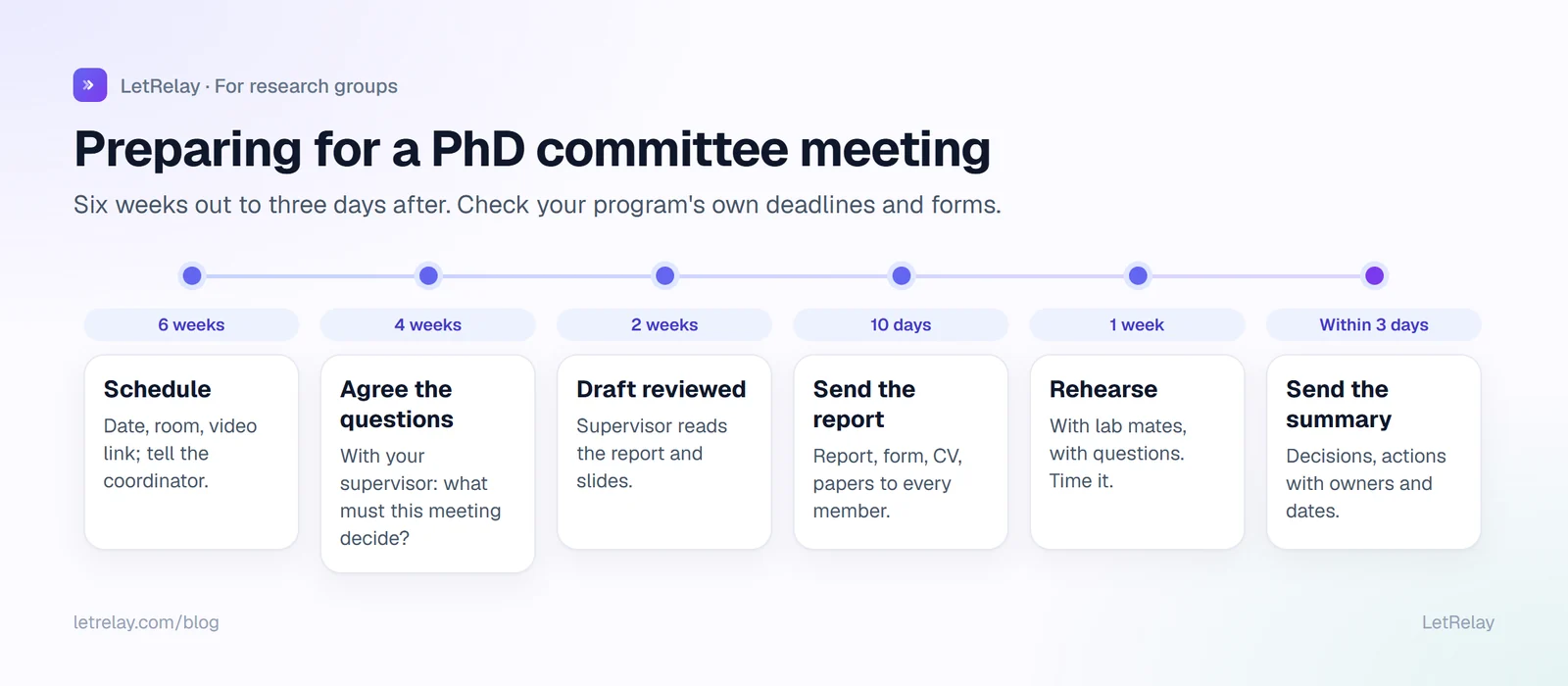
| When | What to do |
|---|---|
| 6 weeks before | Find a date that suits every member. Book a room and a video link. Tell the program coordinator if required. |
| 4 weeks before | Meet your supervisor: what should this meeting decide? Agree the two or three key questions. |
| 3 weeks before | Draft the written report and the slides. |
| 2 weeks before | Supervisor reads the report. Fix it. |
| 10 days before | Send the report, the form, your CV and any papers or preprints to every member. |
| 1 week before | Rehearse with lab mates, with questions. Time it. |
| 1 day before | Reminder to members with the time, room, link and agenda. |
| Within 3 days after | Send a written summary of decisions and actions. File the form. |
The written report
Keep it short: most committees read two to five pages more carefully than fifteen. If your university also asks for a separate progress report, the same facts feed both. A structure that works:
PhD committee report: [name], [program], [date]
Committee: [names]. Previous meeting: [date].

1. Summary (half a page)
   Where the project stands in three to five sentences.

2. Progress since the last meeting
   Against each aim or chapter agreed last time: done, partly done,
   changed, dropped. Key results with one or two figures.

3. Changes to the plan
   What changed and why. Be explicit; committees dislike surprises.

4. Plan and timeline to completion
   Remaining work, papers, and the proposed submission date.

5. Questions for the committee
   The two or three decisions or pieces of advice you need.

6. Training and development
   Courses, conferences, teaching, career plans.

Appendix: publications and preprints; the actions from the last
meeting and their status.
Section 5 is the most important and the one most students leave out. It turns the meeting from a review of you into help for your project.
The presentation: slide outline
About 15 to 20 minutes of slides, then discussion. At roughly a minute per slide, that is 15 to 18 slides.
| Slides | Content |
|---|---|
| 1 | Title, and the questions you want the committee to answer today |
| 2 to 3 | The thesis in one picture: aims or chapters and where each stands |
| 4 | Actions from the last meeting and their status |
| 5 to 12 | Results since last time, one finding per slide with a sentence title |
| 13 | What changed in the plan, and why |
| 14 | Timeline to submission, with papers |
| 15 | The questions again, now with your proposed answers |
Put the questions on slide 1 and again at the end. Committees give better advice when they know from the start what you need. For slide design, the same principles as a lab meeting apply; see lab meeting presentations.
The meeting agenda
1. Student leaves the room (5 min, if your program does this)
   Committee and supervisor discuss progress privately.
2. Supervisor leaves the room (5 min, if your program does this)
   Committee and student talk without the supervisor.
3. Presentation (15 to 20 min), with clarifying questions
4. Discussion of the questions for the committee (20 min)
5. Timeline and next milestone (5 min)
6. Decisions and actions, read back and agreed (5 min)
Some programs build in private time with the student alone. If yours does, use it honestly: it is the committee's way of checking that supervision is working, and the right place to raise a problem you cannot raise with your supervisor in the room.
After the meeting
Send a summary within three days while everyone remembers. Keep it to decisions, actions with owners and dates, and the date or window for the next meeting. File your program's form. Then add each action to your timeline. The first slide of your next committee meeting is this list and what happened to each item.
Committee meeting summary, [date]

Decisions
- Aim 3 narrowed to the in vitro experiments; in vivo work dropped.
- Target submission: May 2028.

Actions
- [Student] Add replicate for figure 4 by 15 January.
- [Student] Circulate paper 2 draft to the committee by 1 March.
- [Supervisor] Confirm funding to September 2028 by 31 January.

Next meeting: within six months, before the paper 2 submission.
For supervisors
- Help set the questions four weeks ahead. A student who arrives with good questions gets a useful meeting.
- Read the report before it goes out. Surprises between supervisor and student should not appear in front of the committee.
- Let the student run the meeting. Answer when asked. A supervisor who presents on the student's behalf tells the committee something too.
- Use the committee. Methods you do not know, a second opinion on scope, a reality check on the timeline: that is what they are for.
- Track the dates. With several students, committee deadlines and forms are easy to miss. Keep them with each student's milestones.
For committee members
- Read the report before the meeting, and send any big concerns to the supervisor in advance.
- Ask questions that help the student decide, not only questions that test them.
- Say clearly, at the end, whether progress is satisfactory and what would change your view.
- If you raise a concern in private time with the student, agree with them how it will be followed up.
How LetRelay does it
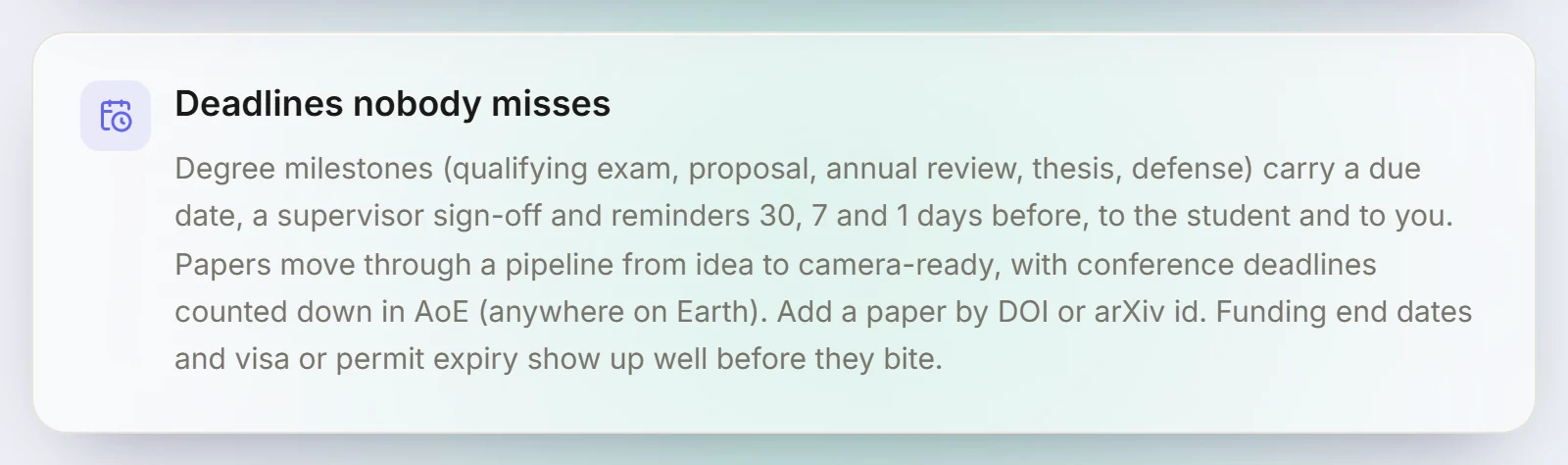
In a LetRelay research group, degree milestones such as the annual review, proposal, thesis and defense carry a due date and a supervisor sign-off, and remind both the student and the supervisor 30, 7 and 1 days before. Notes from 1:1s turn into tasks with owners and dates, so the actions from a committee meeting do not live only in an email. At year end, each student's annual progress report is drafted from the record (milestones, papers, 1:1s, updates), which is most of the committee report already. More on the LetRelay for research groups page.
FAQ
How do I prepare for a PhD committee meeting?
Agree the key questions with your supervisor about four weeks ahead, send a short written report and your program's form around ten days before, rehearse a presentation of about 20 minutes, and send a summary of decisions and actions within a few days afterwards.
What should a PhD committee meeting presentation include?
The questions you want answered, where each aim or chapter stands, the actions from the last meeting, results since then, any change to the plan, and a timeline to submission, ending with your proposed answers to the questions.
How long is a PhD committee meeting?
Often one to two hours, including a presentation of 15 to 20 minutes and discussion. Programs set their own format; check your handbook.
How often do PhD students meet their committee?
Many programs, like the UW–Madison example above, require at least one committee meeting a year, and students often meet more often near the end of the PhD. Some programs also expect an update if a year passes without a meeting.
What happens if the committee is not satisfied with my progress?
Usually they will say what needs to change and ask for another meeting sooner, sometimes within a few months. Ask for the specific concerns in writing, agree a plan with your supervisor, and bring evidence of the changes to the next meeting.
Sources
Building LetRelay, the workspace for research groups and small teams: lab management, supervision tools, and an internal request desk with AI triage and SLA tracking.
Run your research group on LetRelay
Tasks, deadlines, weekly updates and supervision in one place, so you stop chasing students for news. Free for up to 5 people.
Keep reading
PhD Timeline Template: Year-by-Year Plan and Gantt Chart
Year-by-year PhD timelines for US and UK-style programs, a Gantt chart you can build in Excel or Sheets in ten minutes, and how supervisors keep it on track.
How to Ask a Professor for a Recommendation Letter
When to ask, what to send, and the exact emails to use, plus how professors can handle a stack of letter requests without missing a deadline.

PhD Supervision Meeting Agenda: 1:1 Template and Questions
A 1:1 agenda for PhD supervision meetings, questions for your first meeting with a supervisor, a notes template, and how supervisors make meetings count.