New PI Checklist: Setting Up Your Lab in Year One
A phase-by-phase checklist for new faculty: the offer letter, before you arrive, the first month, the first term and year one, plus the systems to set up early.
Setting up a lab happens in five phases. After the offer: get your start-up list, space, teaching relief and start date into the written offer letter. Before you arrive: order long-lead equipment, build a lab website and start recruiting. First month: get the room working and the safety and admin sign-offs done. First term: hire carefully and write down how the lab runs. By the end of year one: a working rhythm of meetings and updates, a first grant submitted, and a first project producing data.
This checklist draws on "A guide to setting up and managing a lab at a research-intensive institution" by Bob Goldstein and Prachee Avasthi (BMC Proceedings, 2021), on the HHMI and Burroughs Wellcome Fund guide "Making the Right Moves", and on the systems a research group needs to run without the PI becoming the bottleneck. Use it as a starting point and adapt it to your field and institution.
Phase 1: after the offer, before you accept
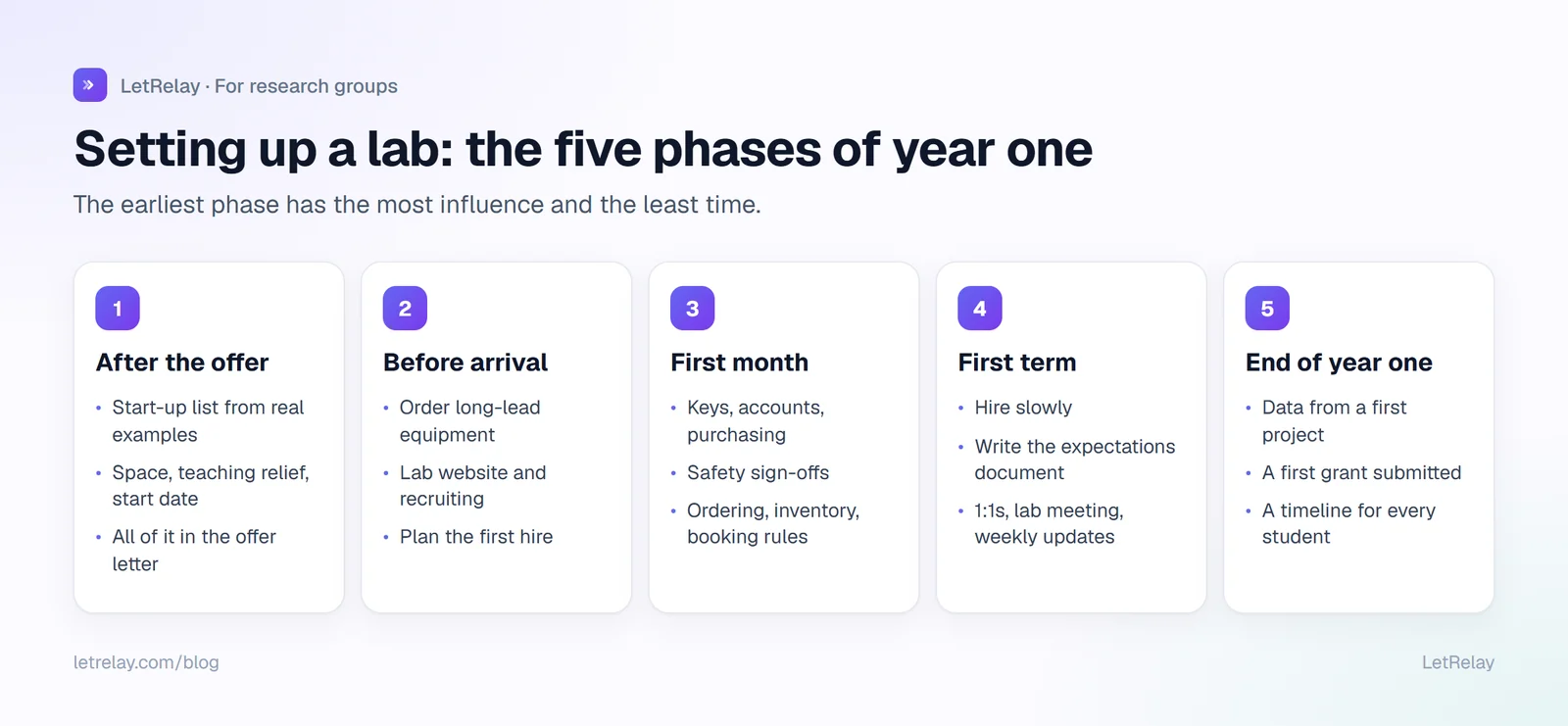
This is the phase with the most influence and the least time. Goldstein and Avasthi make the point that your start-up list is often the best opportunity you will have to secure equipment too expensive for most grants.
- Build the start-up list from real examples. Most people collect start-up lists from peers and communities such as Future PI Slack and New PI Slack rather than starting from scratch.
- Cost personnel properly. Many new PIs ask for one to three years of personnel costs to cover a technician and the first graduate students until the first grant, including fringe benefits and, where relevant, tuition.
- See the space and measure it. Plan one bench and one desk per person, common space for shared equipment, and room to grow, including rotation and summer students.
- Ask whether space is tied to funding. Some institutions, particularly some medical schools, use a formula that links lab space to grant income. Ask how often it is recalculated.
- Get the details written into the offer letter. Teaching load and teaching relief, restrictions on how and when start-up can be spent, the exact space, renovation deadlines with a contingency plan, and whether lab furniture is charged to your start-up.
- Understand the tenure clock. How your start date affects the timeline, teaching and student recruitment.
- Have experienced PIs read the letter before you sign. The offer letter is treated like a contract, and first versions often miss critical details.
Phase 2: before you arrive (3 to 6 months)
- Get visible. Ask to be added to the department and graduate program websites, build a lab website, and announce the lab, so incoming students know you exist.
- Order long-lead equipment. Request demos of large instruments early; delivery and backordered parts can take months. Ask whether you can spend start-up before you arrive.
- Ask about equipment from labs that are closing or moving. Glassware, pipettes and shared equipment are sometimes left behind.
- Plan your first hire. A technician or lab manager who starts when you do, or before, saves you weeks of unpacking and ordering.
- Start protocols and approvals. Animal, human subjects, biosafety and chemical approvals can take months. Start them as early as your institution allows.
- Line up mentors. Senior colleagues who can read your grants, and peers at the same stage to compare notes with.
Phase 3: the first month
- Keys, access cards, accounts, email lists, purchasing system, grant administration contacts.
- Lab safety: institutional training, the lab's safety plan, fume hoods, biosafety cabinets and emergency contacts.
- Order the everyday supplies. Set up the ordering process and the lab inventory from day one, not after the first shortage.
- Set up shared equipment booking with written rules; see fair lab equipment booking.
- Choose the lab's tools: where data and code live, the notebook, the calendar, and where the lab's documents and SOPs go.
- Meet the graduate program director and the people who run rotations and admissions.
Phase 4: the first term
- Hire slowly. Your first people shape the lab's culture for years. Interview properly, talk to references, and do not hire someone because they are available.
- Write down how the lab works. An expectations document covering meetings, hours, communication, authorship and safety. Our lab expectations document guide includes a template.
- Set the meeting rhythm. Regular 1:1s for each person and a weekly lab meeting, both in the calendar. See the PhD supervision meeting agenda and lab meeting presentations.
- Start a written weekly update, even for a lab of two. It is much easier to start a habit than to introduce one later. Our PhD weekly update template takes three minutes to write.
- Onboard every new member the same way. A checklist, not a hallway conversation: our lab onboarding checklist.
- Teach a course first-year graduate students take, if you can. Goldstein and Avasthi suggest it as a way to meet potential rotation students.
Phase 5: by the end of the first year
- A first project producing data, and a realistic plan for the first papers from the new lab.
- A first grant submitted, with a plan for the next funding deadlines, and a way to track each grant's burn rate once it is funded.
- Every student has a written timeline with their program's milestones. Our PhD timeline template helps.
- A record of your activities for tenure: papers, grants, students, teaching, service. Start documenting from day one; it is much harder to reconstruct.
- A review of the expectations document with the lab: what works, what to change.
- One honest look at your own time. Where did the hours go, and what should you stop doing?
Mistakes new PIs commonly make
Goldstein and Avasthi are refreshingly direct about this: new PIs will make mistakes, and it is common to regret some early decisions about hires or equipment. The ones worth trying to avoid:
- Being the only system. When every order, booking, question and deadline goes through the PI's inbox, the lab stops whenever the PI is busy.
- Hiring for availability instead of fit. An empty bench is better than the wrong person.
- No written expectations. Conflicts in a small lab are personal; a document makes them about the agreement instead.
- Buying equipment you rarely use. Use core facilities for occasional needs; buy what you use every week.
- Saying yes to everything. Committees, reviews and talks all look important in year one. Protect research and writing time first.
For the first lab manager or technician
If you are the first hire in a new lab, you will build the systems the lab runs on for years: ordering and inventory, equipment booking and maintenance, safety records, onboarding and the shared calendar. Agree with the PI early what you own, how purchases are approved, and where procedures are written down. Your work is what lets the PI spend time on science.
For students joining a brand-new lab
A new lab offers close supervision and the chance to shape the lab, and also more uncertainty: less equipment at first, no senior students to learn from, and a PI still building their funding. Ask about the PI's start-up funding and how your position is funded, whether the key equipment is installed, and who you can learn techniques from while the lab grows. Our guide on choosing a PhD advisor covers the rest.
How LetRelay does it
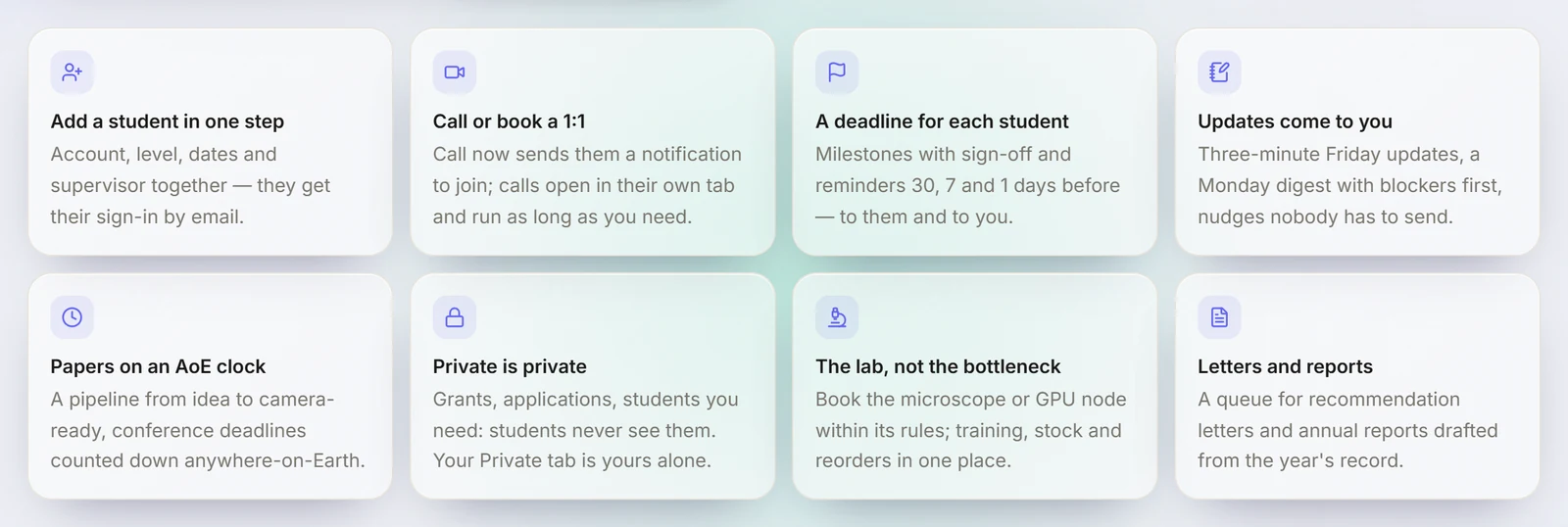
LetRelay is built to be the lab's system from the first month, so the PI does not have to be. Pick "Research group or lab" at sign-up and Research becomes the first tab: add a student with their level, dates and supervisor in one step, and they get their sign-in by email. Friday updates and a Monday digest start the weekly rhythm; milestones remind students and supervisors; students book equipment within the limits you set; consumables have low-stock levels and reorder requests; onboarding and offboarding checklists and a duty roster come with it; and grants show budget lines, spend and burn rate. More on the LetRelay for research groups page.
FAQ
What should a new PI do first?
Before accepting, get the start-up list, space, teaching relief and start date into the written offer letter. Right after accepting, order long-lead equipment, build a lab website to attract students, and plan your first hire.
How much start-up funding should a new PI ask for?
It varies enormously by field and institution, so compare real start-up lists from peers in your field. Include equipment, supplies, and one to three years of personnel costs with fringe benefits and tuition where relevant.
Who should a new PI hire first?
Often a technician or lab manager who can set up the lab and its systems, then graduate students. Hire for fit and reliability rather than availability; the first people set the lab's culture.
How do new PIs manage their time in the first year?
Protect blocks for research and grant writing, set up systems so routine questions do not all come to you, keep teaching relief for when it matters most, and say no to most non-essential service in the first year.
What systems does a new lab need?
Ordering and inventory, equipment booking with rules, a shared calendar, a place for SOPs and lab documents, a written expectations document, a weekly update and 1:1 rhythm, and a way to track each student's milestones.
Sources
Building LetRelay, the workspace for research groups and small teams: lab management, supervision tools, and an internal request desk with AI triage and SLA tracking.
Run your internal requests on LetRelay
AI triage, SLA-tracked queues, and bottleneck analytics — the help desk your team actually likes. Free to start.
Keep reading
Lab Inventory Management: Spreadsheet Template and Tools
The columns a lab inventory spreadsheet needs, how to set reorder levels, a simple ordering workflow, and when to move to free or paid inventory software.
Lab Onboarding Checklist for New PhD Students and Members
A lab onboarding checklist for the first day, first week and first month of a new PhD student, postdoc or visiting researcher, plus the offboarding list that keeps data and keys from walking out the door.
Lab Equipment Booking System: Fair Rules and Free Options
Booking rules that keep shared microscopes, instruments and GPU nodes fair, a copyable policy, and an honest comparison of free and paid lab booking systems.