Individual Development Plan for PhD Students: Template and Guide
What an individual development plan is, which funders expect one (NSF requires it, NIH asks how you use it), a copyable IDP template for PhD students and postdocs, and how a PI can run the annual review in thirty minutes.
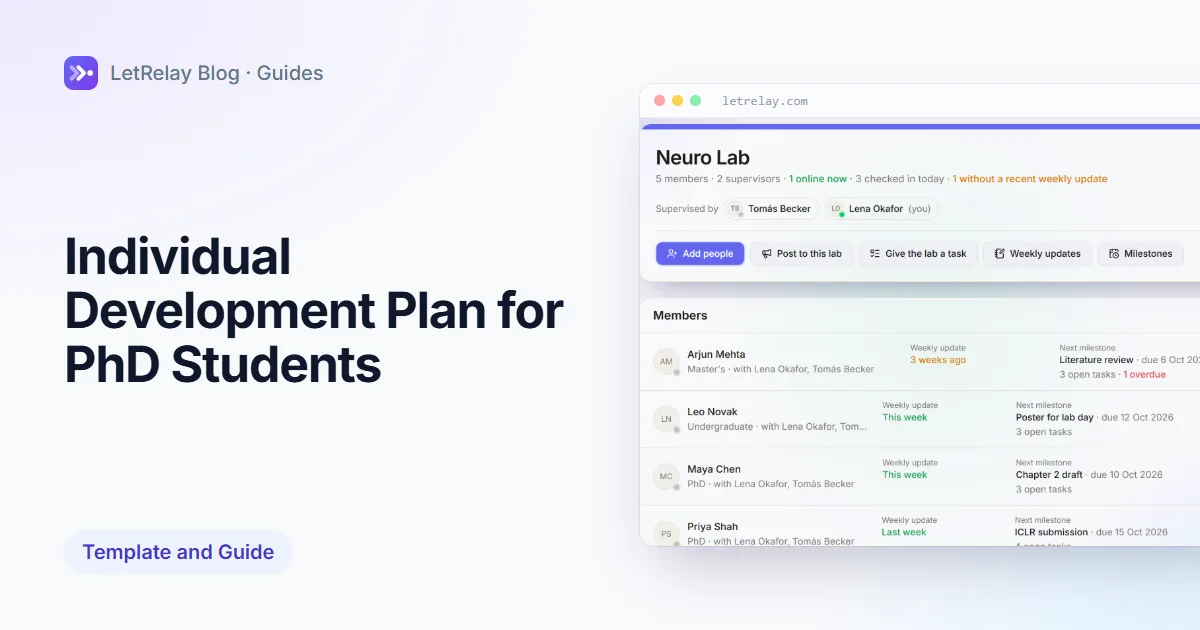
An individual development plan (IDP) for a PhD student is a short written plan, owned by the student and reviewed with their supervisor, that sets career goals, lists the skills and experiences needed to reach them, and puts dates on the next steps. In the United States it is more than good practice: NSF requires one for each graduate student and postdoc with substantial support, and NIH asks every progress report how IDPs are used. The plan itself stays in the lab.
This guide covers what each funder actually says, then gives a template for the student, an agenda for the annual review, and the mistakes that turn an IDP into a form nobody opens. The funder rules below are the US ones. Funders and universities elsewhere have their own training-plan requirements, and we have not covered them here.
What an IDP is, and what it is not
NIGMS, part of NIH, describes the IDP as a planning tool: it should be viewed as a dynamic document that is periodically reviewed and updated throughout training, and it helps mentees and mentors talk to each other. NIGMS encourages IDPs at all training levels, from undergraduates to postdocs.
Three things an IDP is not:
- Not a research plan. The thesis proposal says what science will be done. The IDP says what the person needs to become and learn along the way.
- Not a performance review. The supervisor does not grade it. The student writes it, and the conversation is the point.
- Not a one-time form. A plan written in September and never opened again does nothing.
What NSF and NIH require
The two funders ask for different things, and the difference matters if you hold both kinds of grants.
NSF. Chapter VII.B of the Proposal & Award Policies & Procedures Guide (PAPPG 24-1) says each postdoctoral scholar and graduate student who receives substantial support from an NSF award needs an IDP, updated annually. Substantial support is one person-month or more during the annual reporting period under the award. The IDP maps educational goals, career exploration and professional development. The PI or co-PI certifies in each annual and final annual project report that each qualifying person has one. The plan itself is not something you submit.
NIH. Notice NOT-OD-14-113 says NIH annual progress reports received on or after 1 October 2014 must include a section describing how IDPs are used to identify and promote the career goals of graduate students and postdoctoral researchers associated with the award. NIH says it does not require institutions to use IDPs but strongly encourages them to, and expects the institution to decide whether and how they are used. In the Research Performance Progress Report (RPPR) the answer goes in Section B, Question B.4. The notice says actual IDPs should not be included, and the NIGMS RPPR webinar repeats it: "We do not want to receive actual IDPs." A short description of whether and how they are used is what NIH wants, for the students and postdocs listed in Section D.1. The same response is required for training awards such as T, F, K, R25, R13 and D43. Our RPPR checklist shows where B.4 sits in the whole report.
So under NSF you certify that the plans exist, and under NIH you describe how they are used. In both cases the real record is in your lab, which is the reason to keep it simple enough to maintain.
A template students can fill in
Give the student this, ask them to complete it before the first review, and keep it to three or four pages.
INDIVIDUAL DEVELOPMENT PLAN
Name:                       Programme / year:
Supervisor:                 Date written:        Next review:

1. Where I want to be in 5 years (be honest, it can change)
   Primary direction: [academia / industry research / government /
   teaching / policy / other / undecided]
   What appeals to me about it:
   Two roles I want to learn more about:

2. What I am good at, and what I need to build
   Skill (for example: experimental design, statistics, coding,
   writing, presenting, teaching, project management, leadership)
   | Where I am now (1 to 5) | Where I need to be | How I will build it |

3. This year's research goals
   Three outcomes, each with a month: [paper draft, experiment series,
   chapter, dataset, conference abstract]

4. Training and experience this year
   Courses, workshops, teaching, mentoring a junior, internship, visit,
   conference: what, when, who approves, cost

5. Career exploration
   People to talk to (name, area, by when):
   One thing to try (a shadowing day, an informational interview,
   a non-academic project):

6. Support I need from my supervisor and others
   Time, introductions, funding, feedback, flexibility:

7. Review log
   Date | What changed | New actions
Two practical notes. The skills table is easier to complete than blank paper, because students can see the whole list. And section 6 matters more than it looks: it is where a student can ask for something without having to bring it up cold in a meeting.
The annual review: thirty minutes
Hold the review once a year as a separate meeting, not as the last item of a weekly one-on-one. Ask the student to send the plan two days ahead.
- Read first, talk second (5 min). The supervisor has read it. Open with what stood out.
- Last year (5 min). Which goals were met, and which were dropped? Dropped goals are information, not failures.
- Direction (10 min). Has the five-year picture shifted? Do not steer. Ask what they have learned about what they like.
- Skills and training (5 min). Pick the two skills that matter most and agree how to build each.
- Support (5 min). What will you each do before the next review? Write it down, with dates.
Afterwards the student updates the review log. If you hold NSF funding, that is the moment to note the plan is current for the certification, and the person-month threshold tells you who needs one. For NIH, it gives you a true sentence for B.4.
Where students get stuck
- Writing what they think the supervisor wants. Make clear that a non-academic goal is a normal answer. The plan is more useful when it is honest.
- Goals with no dates. "Improve my writing" does not survive a busy term. "Write the introduction of the review by March, send it to two people for comments" does.
- No link to the weekly rhythm. If the plan lives in a drawer, it is dead. Put its actions into the places work already happens: milestones, tasks, the one-on-one notes. Our supervision meeting agenda has a standing slot for it.
- The PI doing the writing. The student owns the plan. The supervisor reads, asks and helps, and does not complete it.
- Treating it as paperwork for the funder. A plan nobody uses answers the question in the progress report on paper and fails the student in practice.
Running it in LetRelay
LetRelay does not have an IDP form, and we would rather say so than pretend. What it does is hold the parts that make a plan real. The student's milestones carry due dates and a supervisor sign-off, with reminders 30, 7 and 1 days ahead. One-on-one notes keep what was agreed last time, and any line can become a task with an owner and a due date. The weekly update shows blockers. If you keep the IDP as a document in Drive or a notebook, link it from the student's profile and schedule the annual review as a milestone. See the lab expectations document for where career development sits in the group's written agreement, and how to manage PhD students without chasing them for the weekly rhythm around it.
FAQ
What is an individual development plan for a PhD student?
A short written plan, owned by the student and reviewed with a supervisor, covering career goals, the skills and experiences needed, and dated next steps. NIGMS describes it as a dynamic document that is periodically reviewed and updated throughout training.
Is an IDP required?
It depends on your funder. NSF requires one for each postdoctoral scholar and graduate student with substantial support, meaning one person-month or more during the annual reporting period, and the PI certifies it in annual and final project reports. NIH does not require institutions to use IDPs but requires progress reports to describe whether and how they are used.
Do I submit the IDP to the funder?
No. Under NSF you certify that qualifying people have one. Under NIH, the RPPR asks for a short description of how IDPs are used (Section B, Question B.4), and the NIH notice says actual IDPs should not be included.
How often should an IDP be updated?
At least once a year. NSF's rule says updated annually. Many groups also glance at it at the mid-year point, and any time the student's direction changes.
Who writes the IDP, the student or the supervisor?
The student. The supervisor reads it, asks questions and helps with the next steps. A plan the PI writes is a form, not a plan.
What goes in the career exploration section?
The people the student will talk to, with a date, and one small thing to try: an informational interview, a shadowing day, a project outside academia. The goal is to replace guesses about careers with a little evidence before the final year.
Do postdocs need an IDP too?
Yes, under both funders' rules. NSF's requirement covers each postdoctoral scholar and graduate student with substantial support, and NIH's progress-report question covers graduate students and postdocs listed as participants.
Sources
- NIH notice NOT-OD-14-113: Descriptions on the use of IDPs required in annual progress reports
- NSF PAPPG 24-1, Chapter VII: Award Administration (Individual Development Plans)
- NIGMS: Individual Development Plans
- NIGMS: Understanding the Basics of the Research Performance Progress Report (webinar slides, November 2024)
Building LetRelay, the workspace for research groups and small teams: lab management, supervision tools, and an internal request desk with AI triage and SLA tracking.
Run your research group on LetRelay
Tasks, deadlines, weekly updates and supervision in one place, so you stop chasing students for news. Free for up to 5 people.
Keep reading
NSF Postdoc Mentoring Plan: What to Write, With a Template
What NSF's one-page mentoring plan has to cover, who it applies to, how reviewers read it under Broader Impacts, how it differs from an individual development plan, and a fill-in template you can adapt.
Lab Notebook Policy: What to Include (Template for PIs)
What a lab notebook policy should say about entries, corrections, raw data, review, ownership and leaving the lab, with a copyable template built on the NIH record-keeping guidelines.
Lab Meeting Agenda Template: How to Run a Lab Meeting
A copyable lab meeting agenda for 30 and 60 minutes, the three roles that keep it on time, a meeting-notes template with owners and dates, and a rotating monthly format.