PhD Progress Report: Format, Sample and Free Template
How to write a PhD progress report: the sections to include, how often to submit it, a filled-in sample, a free Word template and what to say when progress is slow.
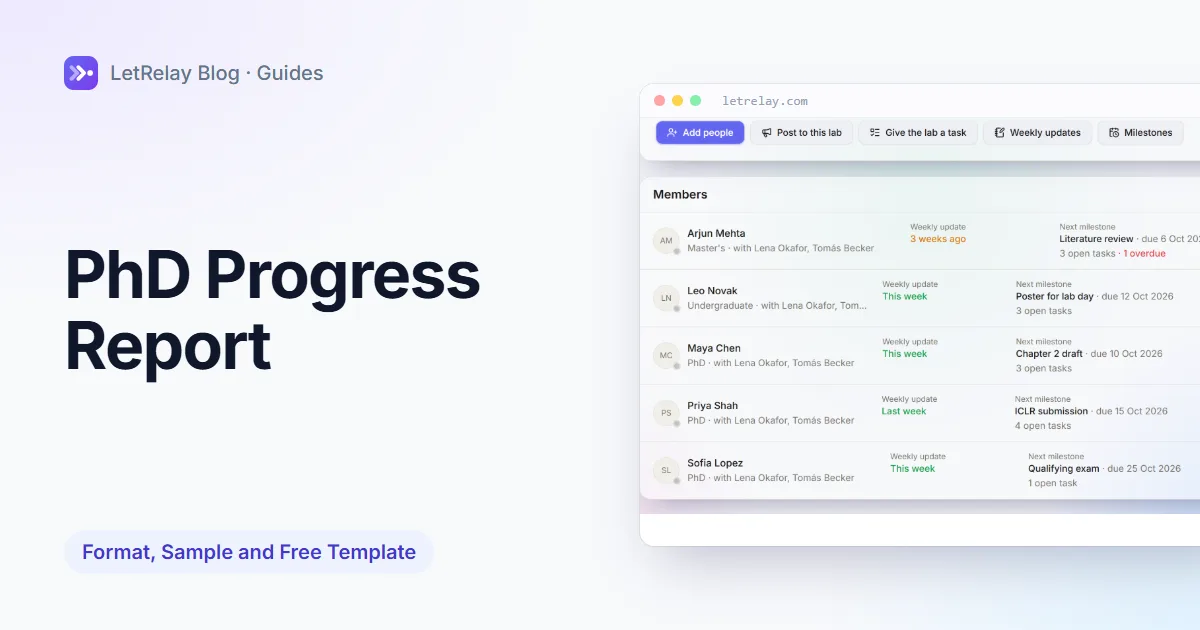
A PhD progress report is a short document in which you tell your supervisor and committee what you did since the last report, what you found, what went wrong, and what you will do next. Universities ask for it every semester, every six months or every year. Use your university's own form if it has one. If not, the free Word template below has the sections most forms ask for, and a filled-in sample shows how to write each one.
Download: PhD progress report template (Word, .docx) and filled-in sample (Word, .docx). Both are free, with no sign-up. The sample is fictional: every name, number and result in it is invented.
What is a PhD progress report?
It is a written update on your research. Your supervisor reads it. In many universities a committee reads it too (it is called a research advisory committee, a doctoral committee or a thesis committee). They use it to check that you are on track, to give you advice, and to decide whether you can move to the next stage.
It is not a thesis chapter and it is not a paper. It is closer to a status report: short, honest and specific. A good one lets a busy reader answer three questions in two minutes: what did you do, did it work, and what happens next?
How often do you have to submit a PhD progress report?
It depends on your university and your country. Three examples:
- India, UGC rules. The University Grants Commission's 2022 Ph.D. regulations say that each semester a scholar appears before the Research Advisory Committee, gives a presentation and submits a brief report on the progress of the work. The committee sends its recommendations, with a copy of the report, to the university, and the scholar gets a copy too. Your university's own ordinance may add details.
- Six-monthly reports. The rules of Vardhman Mahaveer Open University for its research committees say a research scholar submits a six-monthly progress report to the committee for evaluation and guidance.
- Canada, UBC Computer Science. Every PhD student must meet the supervisory committee at least once a year and submit an annual report that describes the past year's activities and the plans for the next year.
Ask your department office three things: how often, which form, and who signs it. Then put the dates in your calendar with a reminder a few weeks before. Our guide to the PhD committee meeting covers the meeting that usually goes with the report.
Why it matters. Under the UGC rules, if progress is unsatisfactory the committee records the reasons and suggests corrective measures. Only if the scholar then fails to follow them may the committee recommend cancelling the registration, and it has to give specific reasons. That is a last step, not a first one. A clear report with a realistic plan is the best protection you have.
PhD progress report format: the sections to include
Forms differ, but most ask for the same things. UBC Computer Science's form, for example, has student details, talks and publications, academic progress (courses and milestones), a written account of the past year, goals for the coming year, and the committee's approval. Use the list below as a base and drop whatever your form does not ask for.
| Section | What to write | Suggested length |
|---|---|---|
| 1. Student and project details | Name, registration number, department, supervisor, committee, reporting period | A small table |
| 2. Working title | The current title. Say if it changed and why | One line |
| 3. Summary | Your question, what you did, the main result, the biggest problem, what comes next | 4 to 6 sentences |
| 4. Objectives and progress | Each objective from your approved plan, with a status: Done, Partly or Not started | A table |
| 5. Work done and results | What you did, in order, with dates. What you found, and how sure you are | One to two pages |
| 6. Problems and changes | What went wrong, the effect, what you are doing about it, what you need | A few lines each |
| 7. Courses, training, teaching | Name, dates, grade or status | A table |
| 8. Publications and presentations | Papers, talks and posters, with their status | A table |
| 9. Thesis chapter status | Each chapter: not started, outline, draft or revised | A table |
| 10. Plan for the next period | Four to eight tasks with dates and something you can show | A table |
| 11. Support needed | Equipment, data, training, introductions | 2 to 3 lines |
| 12. Signatures | You, your supervisor, and the committee if your university needs it | Lines |
Free PhD progress report template (Word)
Download the PhD progress report template (.docx). It has all the sections above (the signatures are split into a student declaration, a supervisor's assessment and an optional committee section), grey guidance lines under every heading, and empty tables you can fill in. It is a standard .docx file, so it should open in Word, Google Docs and LibreOffice.
How to use it:
- Check your university's form first. If a form exists, use it. Use this template only for sections the form is missing, or when your university has no form.
- Fill in the dry parts first: details, courses, publications and the chapter table.
- Write sections 4 to 6, then the plan in section 10. The summary comes last.
- Delete the grey guidance lines and the yellow box at the top. Send it to your supervisor at least a week before the deadline.
If you prefer plain text, copy this into any document or email and fill it in:
PHD PROGRESS REPORT
Reporting period: [from] to [to]     Report no.: [1, 2, ...]

1. DETAILS
Name:
Registration number:
Department and university:
Programme and start date:
Supervisor(s):
Committee members:
Date submitted:

2. WORKING TITLE
[Current title. If it changed: what changed and why.]

3. SUMMARY (4 to 6 sentences)
[My question. What I did. Main result. Biggest problem. What comes next.]

4. OBJECTIVES AND PROGRESS
Objective 1: [from my approved plan]
  Planned for this period: [what]
  Status: Done / Partly / Not started
  Comment: [one line, with a date or number]

5. WORK DONE AND RESULTS
5.1 Work completed: [what, in order, with dates]
5.2 Results so far: [what I found; how sure I am; Figure 1, Table 1]
5.3 What this means for the thesis: [which chapter; what is still missing]

6. PROBLEMS AND CHANGES TO THE PLAN
Problem: [what went wrong]
Effect: [what it delayed or changed]
Action: [what I am doing about it]
Help needed: [what, from whom]

7. COURSES AND TRAINING: [name, dates, grade or status]
8. PUBLICATIONS AND PRESENTATIONS: [type, title and venue, status, date]
9. THESIS CHAPTER STATUS: [chapter, not started / outline / draft / revised, next draft date]

10. PLAN FOR THE NEXT PERIOD
Task | Start | End | What I will have to show

11. SUPPORT NEEDED: [equipment, data, training, introductions]

12. SIGNATURES
Student: ______   Date: ______
Supervisor's assessment: Satisfactory, on schedule / Satisfactory, with suggestions / Unsatisfactory
Supervisor: ______   Date: ______
PhD progress report sample (filled-in example)
Here is a short first six-month report for a fictional student. The full sample, with every section filled in, is the Word download. Do not copy the wording. Write about your own work.
Summary. "In this period I finished the literature review, designed and set up the field experiment (three mulched and three unmulched plots at the university farm) and collected the first soil moisture data. Early readings show higher soil moisture in the mulched plots at 10 cm depth, by about 3 percentage points on average; this is one season and not yet tested statistically. The main problem was a five-week delay in getting the moisture sensors, which I covered with hand sampling. Next period I will complete the winter wheat season, analyse the data and draft the methods chapter."
Objectives and progress.
| # | Objective | Planned for this period | Status | Comment |
|---|---|---|---|---|
| 1 | Review the literature on mulching and soil moisture | About 40 papers | Done | Draft review (6,200 words) sent to my supervisor on 12 November |
| 2 | Design and set up the field experiment | Plots ready by 1 October | Done, 2 weeks late | Six plots: two treatments, three replicates each |
| 3 | Collect soil moisture data | Weekly readings from October | Done, method changed | 11 weekly readings: 5 by hand sampling before the sensors arrived, 6 with sensors |
| 4 | Pass the research methods course | Pass | Done | Passed in October |
A problem, with a plan. "Moisture sensors arrived five weeks late. Effect: five weekly readings had to be taken by hand, which is less precise. Action: weekly hand sampling (oven-dry method) until the sensors were installed on 25 November. Help needed: Friday access to the drying oven, which my supervisor will ask the lab manager to approve."
Plan for the next period.
| Task | Start | End | What I will have to show |
|---|---|---|---|
| Finish the winter wheat season: weekly moisture readings | Jan 2026 | Apr 2026 | A complete 24-week data set |
| Draft the methods chapter | Feb 2026 | Mar 2026 | A 10-page draft to my supervisor |
| Analyse the moisture data | Apr 2026 | May 2026 | Tables and figures for chapter 4 |
| Write the review paper | Apr 2026 | May 2026 | A submitted manuscript |
Why this works:
- The summary can be read alone. A committee member who reads only that paragraph still knows where things stand.
- Every objective has a status. "Done, method changed" is honest and specific. It tells the reader what to ask about.
- The result comes with its limits. "One season, not yet tested statistically" shows you know what the data can and cannot say.
- The problem comes with an action and a request. It reads as management, not as an excuse.
- Every planned task has dates and something to show. At the next report, anyone can check what was done.
How to write a PhD progress report: eight tips
- Write the summary last. You cannot summarise what you have not written yet.
- Start from your approved plan. Copy the objectives from your synopsis or proposal word for word, so the reader can compare plan and progress. If you do not have one yet, our guide to the PhD synopsis format shows how to write it.
- Put results before activities. Write "soil moisture was higher in mulched plots", then how you measured it. Do not open with "I installed sensors".
- Use numbers and dates. "Read 41 papers" and "plots sown on 14 October" are better than "made good progress".
- Say how sure you are. One season, one sample, one pilot: say so. Committees trust a careful claim more than a big one.
- Say what changed, and why. Plans change. A change with a reason is normal. A silent change looks like a problem.
- Make next-period tasks checkable. If nobody can tell whether a task is done, it is not a plan. Draw the timeline with the free PhD Gantt chart maker and attach the picture.
- Give your supervisor nothing new. Nothing in the report should surprise them. A short weekly update and regular supervision meetings mean the report only collects what they already know.
How long should a PhD progress report be?
Follow the limit on your form. If there is none, two to four pages plus figures is a sensible aim for a six-month or annual report. A first report can be shorter than a final-year report because there is less to show. A longer report is not a better report: a committee member may read many of them in one afternoon.
PhD progress report PPT: slide-by-slide outline
Under the UGC rules a scholar also presents to the committee each semester, and many universities ask for slides with the report. Here is an outline that works for most:
- Title. Your name, thesis title, supervisor, date and report number.
- Research question and objectives. One slide, using the same objectives as in your plan.
- What you promised last time, and what happened. The objectives table with a status for each.
- Methods. Only what the reader needs in order to trust the results.
- Results. One or two slides. One message per slide, with labelled figures.
- Problems and changes. The problem, the effect and what you are doing.
- Plan for the next period. A Gantt chart with dates and deliverables.
- Publications, courses and what you need. End on a specific question for the committee.
Ask how long you get. As a rough rule, plan about one slide per minute and leave time for questions.
What if you made very little progress?
Say so, early and plainly, and bring a plan. Committees can help with a problem they know about. They cannot help with one they find out about later. Fill in this sentence pattern:
I planned [objective] for this period.
I completed [part] but not [the rest] because [specific reason].
This delays [thing] by about [time].
To recover I will [action] by [date].
I need [help] from [person].
Two examples:
- "I planned to finish data collection. I completed 14 of 20 interviews because two participants withdrew and the ethics amendment for new sites took five weeks. This delays analysis by about a month. To recover I will interview six people at the new sites by 15 March and start coding the first 14 now. I need my supervisor to introduce me to the second site."
- "I planned to submit the first paper. I did not, because the experiment needed repeating after the equipment fault in October. The paper is delayed by about three months. I will repeat the experiment by 30 January and submit by 30 April. I need two weeks of instrument time."
If illness, family problems or visa issues affected your work, tell your supervisor before you write the report and ask about official leave or an extension. Many universities have a process for it, and it is much easier to use before a deadline than after.
What does the supervisor's section cover?
It varies. In the UBC Computer Science process, the committee meets the student after approving the report, and the supervisor sends the department a brief report with a decision on progress: satisfactory and on schedule, satisfactory with suggestions, or unsatisfactory, plus optional comments. Other universities ask for free comments, a mark or a signature. Your job is to give your supervisor the draft in good time, because they usually have to write their part and sign before the deadline.
For supervisors and departments
A few habits make progress reports useful instead of a formality:
- Use one template for the whole group. Reports become easy to compare, and students stop guessing what you expect.
- Ask for the draft two weeks before the deadline. That leaves time for a real conversation.
- Answer in writing, in three lines. What went well, what worries you, what to do next. Students keep it.
- Keep every report. Next year's report starts from this year's plan, so the committee can see promises and results side by side.
- Treat a surprise as a signal. If a report tells you something new, the weekly contact is not working. See our timeline guide for tracking milestones across a whole group.
How LetRelay does it
In a LetRelay research group, degree milestones such as the annual review, proposal, thesis and defense carry a due date and a supervisor sign-off, and remind both the student and the supervisor 30, 7 and 1 days before. Students send a short weekly update, and 1:1 notes turn into tasks with owners and dates. At year end, each student's annual progress report is drafted from that record (milestones, papers, 1:1s and updates), which is most of the report already. More on the LetRelay for research groups page.
FAQ
How do I write a PhD progress report?
Start from your approved plan. List each objective with a status (done, partly, not started), then describe the work done and the results, the problems and what you are doing about them, and a plan for the next period with dates. Write the summary last, use numbers and dates, and give your supervisor the draft a week or two before the deadline.
What should a 6-month PhD progress report include?
Your details and the reporting period, the working title, a short summary, progress against each objective, the work done and results so far, problems and changes, courses and training, publications and presentations, thesis chapter status, a plan for the next six months, and signatures. A first six-month report is often short, because much of the time went on reading and planning.
How many pages should a PhD progress report be?
Follow the limit on your university's form. Without a limit, aim for two to four pages plus figures. Some forms are one page and some are longer, so check before you write.
Who signs a PhD progress report?
Usually you and your supervisor. Some universities also need the research advisory committee, doctoral committee or head of department to sign. Ask your department office which signatures are required and in what order.
What happens if my PhD progress is unsatisfactory?
Under the UGC rules in India, the committee records the reasons and suggests corrective measures. If the scholar fails to follow them, the committee may recommend, with specific reasons, that the registration be cancelled. Other universities have their own steps, usually starting with a warning and a plan. Bring a recovery plan with dates to your next meeting.
Can I reuse my last progress report for the next one?
Use it as a starting point, not a copy. Move the "plan for the next period" table into the "objectives and progress" table of the new report and give each task a status. The committee then sees what you promised and what happened. Write fresh text for the work and results.
Is there a PhD progress report sample in PDF?
The sample here is a Word file so you can edit it. To get a PDF, open it in Word and choose File, then Save as PDF. Your university's own form always comes before any sample.
Sources
- University Grants Commission (Minimum Standards and Procedures for Award of Ph.D. Degree) Regulations, 2022 (PDF), regulations 10 and 11
- Vardhman Mahaveer Open University: Constitution of the Research Advisory Committee and Doctoral Research Committee (PDF)
- UBC Department of Computer Science: Annual PhD Progress Report form (PDF)
Building LetRelay, the workspace for research groups and small teams: lab management, supervision tools, and an internal request desk with AI triage and SLA tracking.
Run your research group on LetRelay
Tasks, deadlines, weekly updates and supervision in one place, so you stop chasing students for news. Free for up to 5 people.
Keep reading
PhD Supervision Meeting Agenda: 1:1 Template and Questions
A 1:1 agenda for PhD supervision meetings, questions for your first meeting with a supervisor, a notes template, and how supervisors make meetings count.
How to Write a Recommendation Letter for a Graduate Student
A paragraph-by-paragraph structure, an example letter, the phrases that quietly weaken a letter, and a workflow for PIs writing dozens each season.
How to Email a Potential PhD Supervisor (With Examples)
When emailing a professor helps your PhD application and when it does not, what to write, two example emails, and how PIs can handle inquiries fairly.